


Page 160 - (DK) Help Your Kids with Language Arts
P. 160
158 SPELLING
Capital letters SEE ALSO
22–23 Nouns
THE MOST COMMON USE OF A CAPITAL LETTER 34–35 Pronouns
68–69 Sentences
IS AT THE BEGINNING OF A SENTENCE. 92–93 What is punctuation?
In addition to starting sentences, capital letters are used 94–95 Periods and ellipses
Abbreviations 172–173
for the names of people and places, and expressions Making sentences interesting 184–185
of time, such as days of the week. Checking and editing 220–221
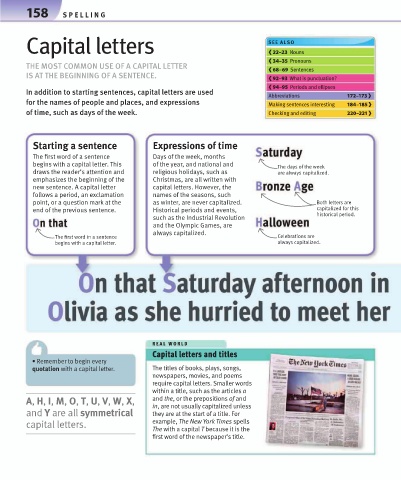
Starting a sentence Expressions of time
The first word of a sentence Days of the week, months
begins with a capital letter. This of the year, and national and
The days of the week
draws the reader’s attention and religious holidays, such as are always capitalized.
emphasizes the beginning of the Christmas, are all written with
new sentence. A capital letter capital letters. However, the
follows a period, an exclamation names of the seasons, such
point, or a question mark at the as winter, are never capitalized. Both letters are
end of the previous sentence. Historical periods and events, capitalized for this
historical period.
such as the Industrial Revolution
and the Olympic Games, are
always capitalized.
The first word in a sentence Celebrations are
begins with a capital letter. always capitalized.
REAL W OR L D
Capital letters and titles
• Remember to begin every
quotation with a capital letter. The titles of books, plays, songs,
newspapers, movies, and poems
require capital letters. Smaller words
within a title, such as the articles a
A, H, I, M, O, T, U, V, W, X, and the, or the prepositions of and
in, are not usually capitalized unless
and Y are all symmetrical they are at the start of a title. For
capital letters. example, The New York Times spells
The with a capital T because it is the
first word of the newspaper’s title.

