


Page 360 - (DK) Ocean - The Definitive Visual Guide
P. 360
358     ANIMAL LIFE


                  ORDER SCORPAENIFORMES         ORDER SCORPAENIFORMES         ORDER SCORPAENIFORMES     The adult lumpsucker (or lumpfish) has
                                                                                                        a slightly grotesque appearance because
               Spotted Scorpionfish          East Atlantic                 Lumpsucker                   the first dorsal fin becomes overgrown
                                                                                                        with thick, lumpy skin. Other bony
                                             Red Gurnard
               Scorpaena plumieri                                          Cyclopterus lumpus           lumps and bumps stick out in irregular
                              LENGTH                                                     LENGTH         rows along its large, rounded body. The
                                             Chelidonichthys cuculus
                              Up to 18 in (45 cm)                                        Up to 24 in (60 cm)  pelvic fins form a strong sucker disk on
                                                           LENGTH                                       its belly, which the lumpsucker uses to
                              WEIGHT                                                     WEIGHT
                              Up to 3 1 / 4 lb (1.5 kg)    Up to 20 in (50 cm)           Up to 21 lb (9.5 kg)  cling to wave-battered rocks near the
                                                           WEIGHT                                       shore where it spawns. The male guards
                              DEPTH                                                      DEPTH
                              3–200 ft (1–60 m)            Not recorded                  7–1,300 ft (2–400 m)  the eggs from crabs and also fans them.
                                                           DEPTH
               DISTRIBUTION  Western Atlantic and eastern Atlantic         DISTRIBUTION  Temperate and cold waters of north   Lumpsucker eggs are marketed as
               around Ascension Island and St. Helena      50–1,300 ft (15–400 m)  Atlantic             substitute caviar.
                                             DISTRIBUTION  Temperate waters of northeastern
                                             Atlantic and Mediterranean
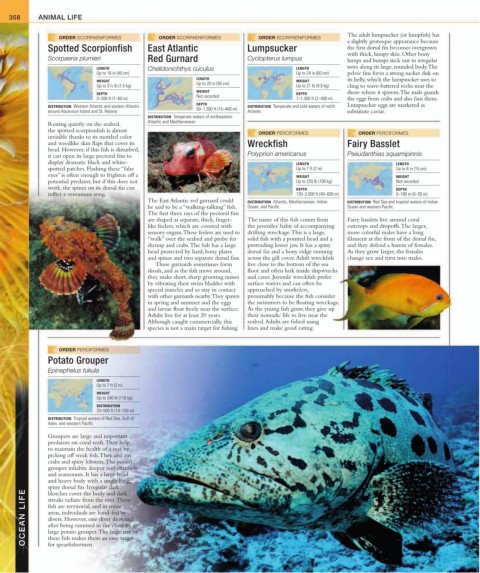
               Resting quietly on the seabed,
               the spotted scorpionfish is almost                             ORDER PERCIFORMES             ORDER PERCIFORMES
               invisible thanks to its mottled color
               and weedlike skin flaps that cover its                      Wreckfish                    Fairy Basslet
               head. However, if this fish is disturbed,
               it can open its large pectoral fins to                      Polyprion americanus         Pseudanthias squamipinnis
               display dramatic black and white-                                         LENGTH                        LENGTH
               spotted patches. Flashing these “false                                    Up to 7 ft (2 m)              Up to 6 in (15 cm)
               eyes” is often enough to frighten off a                                   WEIGHT                        WEIGHT
               potential predator, but if this does not                                  Up to 220 lb (100 kg)         Not recorded
               work, the spines on its dorsal fin can                                    DEPTH                         DEPTH
               inflict a venomous sting.                                                 130–2,000 ft (40–600 m)       0–180 m (0–55 m)
                                             The East Atlantic red gurnard could   DISTRIBUTION  Atlantic, Mediterranean, Indian   DISTRIBUTION  Red Sea and tropical waters of Indian
                                             be said to be a “walking-talking” fish.   Ocean, and Pacific  Ocean and western Pacific
                                             The first three rays of the pectoral fins
                                             are shaped as separate, thick, finger-  The name of this fish comes from    Fairy basslets live around coral
                                             like feelers, which are covered with   the juveniles’ habit of accompanying   outcrops and dropoffs. The larger,
                                             sensory organs. These feelers are used to   drifting wreckage. This is a large,    more colorful males have a long
                                             “walk” over the seabed and probe for   solid fish with a pointed head and a   filament at the front of the dorsal fin,
                                             shrimp and crabs. The fish has a large   protruding lower jaw. It has a spiny   and they defend a harem of females.
                                             head protected by hard, bony plates   dorsal fin and a bony ridge running   As they grow larger, the females
                                             and spines and two separate dorsal fins.   across the gill cover. Adult wreckfish   change sex and turn into males.
                                               These gurnards sometimes form   live close to the bottom of the sea
                                             shoals, and as the fish move around,   floor and often lurk inside shipwrecks
                                             they make short, sharp grunting noises   and caves. Juvenile wreckfish prefer
                                             by vibrating their swim bladder with   surface waters and can often be
                                             special muscles and so stay in contact   approached by snorkelers,
                                             with other gurnards nearby. They spawn   presumably because the fish consider
                                             in spring and summer and the eggs   the swimmers to be floating wreckage.
                                             and larvae float freely near the surface.   As the young fish grow, they give up
                                             Adults live for at least 20 years.   their nomadic life to live near the
                                             Although caught commercially, this   seabed. Adults are fished using
                                             species is not a main target for fishing.   lines and make good eating.


                  ORDER PERCIFORMES
               Potato Grouper

               Epinephelus tukula
                              LENGTH
                              Up to 7 ft (2 m)
                              WEIGHT
                              Up to 240 lb (110 kg)
                              DISTRIBUTION
                              33–500 ft (10–150 m)
               DISTRIBUTION  Tropical waters of Red Sea, Gulf of
               Aden, and western Pacific
               Groupers are large and important
               predators on coral reefs. They help
               to maintain the health of a reef by
               picking off weak fish. They also eat
               crabs and spiny lobsters. The potato
               grouper inhabits deeper reef channels
               and seamounts. It has a large head
               and heavy body with a single long,
               spiny dorsal fin. Irregular dark
        OCEAN LIFE  fish are territorial, and in some
               blotches cover the body and dark
               streaks radiate from the eyes. These
               areas, individuals are hand-fed by
               divers. However, one diver drowned
               after being rammed in the chest by a
               large potato grouper. The large size of
               these fish makes them an easy target
               for spearfishermen.

