


Page 363 - (DK) Ocean - The Definitive Visual Guide
P. 363
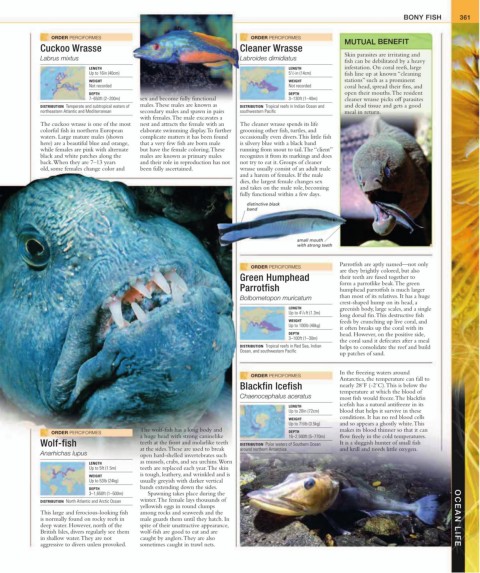
BONY FISH 361
ORDER PERCIFORMES ORDER PERCIFORMES
MUTUAL BENEFIT
Cuckoo Wrasse Cleaner Wrasse
Skin parasites are irritating and
fish can be debilitated by a heavy
Labrus mixtus Labroides dimidiatus
LENGTH LENGTH infestation. On coral reefs, large
1
Up to 16in (40cm) 5 / 2 in (14cm) fish line up at known “cleaning
WEIGHT WEIGHT stations” such as a prominent
Not recorded Not recorded coral head, spread their fins, and
DEPTH DEPTH open their mouths. The resident
7–650ft (2–200m) sex and become fully functional 3–130ft (1–40m) cleaner wrasse picks off parasites
DISTRIBUTION Temperate and subtropical waters of males. These males are known as DISTRIBUTION Tropical reefs in Indian Ocean and and dead tissue and gets a good
northeastern Atlantic and Mediterranean secondary males and spawn in pairs southwestern Pacific meal in return.
with females. The male excavates a
The cuckoo wrasse is one of the most nest and attracts the female with an The cleaner wrasse spends its life
colorful fish in northern European elaborate swimming display. To further grooming other fish, turtles, and
waters. Large mature males (shown complicate matters it has been found occasionally even divers. This little fish
here) are a beautiful blue and orange, that a very few fish are born male is silvery blue with a black band
while females are pink with alternate but have the female coloring. These running from snout to tail. The “client”
black and white patches along the males are known as primary males recognizes it from its markings and does
back. When they are 7–13 years and their role in reproduction has not not try to eat it. Groups of cleaner
old, some females change color and been fully ascertained. wrasse usually consist of an adult male
and a harem of females. If the male
dies, the largest female changes sex
and takes on the male role, becoming
fully functional within a few days.
distinctive black
band
small mouth
with strong teeth
ORDER PERCIFORMES Parrotfish are aptly named—not only
are they brightly colored, but also
Green Humphead their teeth are fused together to
form a parrotlike beak. The green
Parrotfish humphead parrotfish is much larger
than most of its relatives. It has a huge
crest-shaped hump on its head, a
Bolbometopon muricatum
LENGTH greenish body, large scales, and a single
1
Up to 4 / 4 ft (1.3m)
long dorsal fin. This destructive fish
WEIGHT feeds by crunching up live coral, and
Up to 100lb (46kg)
it often breaks up the coral with its
DEPTH head. However, on the positive side,
3–100ft (1–30m)
the coral sand it defecates after a meal
DISTRIBUTION Tropical reefs in Red Sea, Indian helps to consolidate the reef and build
Ocean, and southwestern Pacific
up patches of sand.
ORDER PERCIFORMES In the freezing waters around
Antarctica, the temperature can fall to
Blackfin Icefish nearly 28˚F (-2˚C). This is below the
temperature at which the blood of
Chaenocephalus aceratus most fish would freeze. The blackfin
LENGTH icefish has a natural antifreeze in its
Up to 28in (72cm) blood that helps it survive in these
WEIGHT conditions. It has no red blood cells
Up to 7½lb (3.5kg) and so appears a ghostly white. This
ORDER PERCIFORMES The wolf-fish has a long body and DEPTH makes its blood thinner so that it can
a huge head with strong caninelike 16–2,500ft (5–770m) flow freely in the cold temperatures.
Wolf-fish teeth at the front and molarlike teeth DISTRIBUTION Polar waters of Southern Ocean It is a sluggish hunter of small fish
at the sides. These are used to break around northern Antarctica and krill and needs little oxygen.
Anarhichas lupus open hard-shelled invertebrates such
LENGTH as mussels, crabs, and sea urchins. Worn
Up to 5ft (1.5m) teeth are replaced each year. The skin
WEIGHT is tough, leathery, and wrinkled and is
Up to 53lb (24kg) usually greyish with darker vertical
DEPTH bands extending down the sides.
3–1,650ft (1–500m) Spawning takes place during the
DISTRIBUTION North Atlantic and Arctic Ocean winter. The female lays thousands of
yellowish eggs in round clumps
This large and ferocious-looking fish among rocks and seaweeds and the
is normally found on rocky reefs in male guards them until they hatch. In OCEAN LIFE
deep water. However, north of the spite of their unattractive appearance,
British Isles, divers regularly see them wolf-fish are good to eat and are
in shallow water. They are not caught by anglers. They are also
aggressive to divers unless provoked. sometimes caught in trawl nets.

