


Page 42 - AirForces - Monthly (February 2020)
P. 42
VFC-111 ‘Sundowners’


              to-head with fleet pilots as they sharpen
              their skills in dogfights and aerial combat.
              As an Active-Reserve Integration (ARI) unit,
              VFC-111 is composed of both regular navy
              and US Navy Reserve personnel. It is made
              up of experienced active-duty officers, full-
              time support reservists, and selected reserves.
              Its main advantage is its proximity to the
              Gulf of Mexico, offering a vast airspace over
              the sea without any other air traffic nearby,
              while its favourable weather conditions
              provide sunshine almost all year round.
              VFC-111’s location at NAS Key West, home of
              the navy’s Strike Fighter Advanced Readiness
              Program (SFARP), also eliminates costly
              adversary detachments and provides a
              significant portion of adversary support to all
              F/A-18 fleet replacement squadrons (FRS) in
              the navy and USMC. Among its ‘customers’
              are Strike Fighter Squadron 106 (VFA-106) at
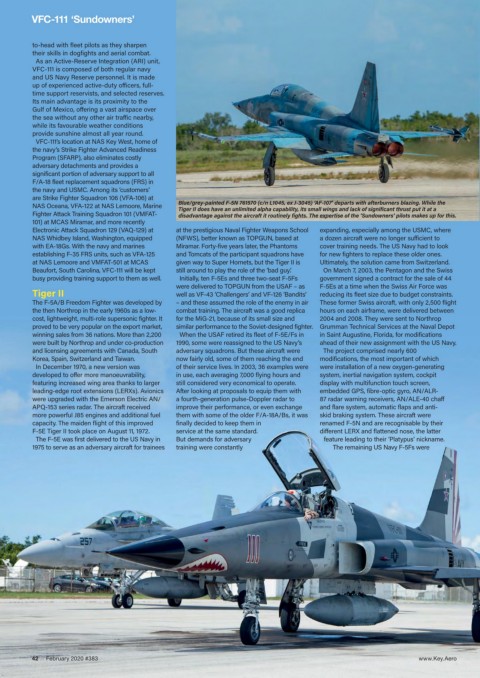
              NAS Oceana, VFA-122 at NAS Lemoore, Marine   Blue/grey-painted F-5N 761570 (c/n L1045, ex J-3045) ‘AF-107’ departs with afterburners blazing. While the
                                                  Tiger II does have an unlimited alpha capability, its small wings and lack of significant thrust put it at a
              Fighter Attack Training Squadron 101 (VMFAT-  disadvantage against the aircraft it routinely fights. The expertise of the ‘Sundowners’ pilots makes up for this.
              101) at MCAS Miramar, and more recently
              Electronic Attack Squadron 129 (VAQ-129) at   at the prestigious Naval Fighter Weapons School   expanding, especially among the USMC, where
              NAS Whidbey Island, Washington, equipped   (NFWS), better known as TOPGUN, based at   a dozen aircraft were no longer sufficient to
              with EA-18Gs. With the navy and marines   Miramar. Forty-five years later, the Phantoms   cover training needs. The US Navy had to look
              establishing F-35 FRS units, such as VFA-125   and Tomcats of the participant squadrons have   for new fighters to replace these older ones.
              at NAS Lemoore and VMFAT-501 at MCAS   given way to Super Hornets, but the Tiger II is   Ultimately, the solution came from Switzerland.
              Beaufort, South Carolina, VFC-111 will be kept   still around to play the role of the ‘bad guy’ .  On March 7, 2003, the Pentagon and the Swiss
              busy providing training support to them as well.  Initially, ten F-5Es and three two-seat F-5Fs   government signed a contract for the sale of 44
                                                 were delivered to TOPGUN from the USAF – as   F-5Es at a time when the Swiss Air Force was
              Tiger II                           well as VF-43 ‘Challengers’ and VF-126 ‘Bandits’   reducing its fleet size due to budget constraints.
              The F-5A/B Freedom Fighter was developed by   – and these assumed the role of the enemy in air   These former Swiss aircraft, with only 2,500 flight
              the then Northrop in the early 1960s as a low-  combat training. The aircraft was a good replica   hours on each airframe, were delivered between
              cost, lightweight, multi-role supersonic fighter. It   for the MiG-21, because of its small size and   2004 and 2008. They were sent to Northrop
              proved to be very popular on the export market,   similar performance to the Soviet-designed fighter.  Grumman Technical Services at the Naval Depot
              winning sales from 36 nations. More than 2,200   When the USAF retired its fleet of F-5E/Fs in   in Saint Augustine, Florida, for modifications
              were built by Northrop and under co-production   1990, some were reassigned to the US Navy’s   ahead of their new assignment with the US Navy.
              and licensing agreements with Canada, South   adversary squadrons. But these aircraft were   The project comprised nearly 600
              Korea, Spain, Switzerland and Taiwan.  now fairly old, some of them reaching the end   modifications, the most important of which
              In December 1970, a new version was   of their service lives. In 2003, 36 examples were   were installation of a new oxygen-generating
              developed to offer more manoeuvrability,   in use, each averaging 7,000 flying hours and   system, inertial navigation system, cockpit
              featuring increased wing area thanks to larger   still considered very economical to operate.   display with multifunction touch screen,
              leading-edge root extensions (LERXs). Avionics   After looking at proposals to equip them with   embedded GPS, fibre-optic gyro, AN/ALR-
              were upgraded with the Emerson Electric AN/  a fourth-generation pulse-Doppler radar to   87 radar warning receivers, AN/ALE-40 chaff
              APQ-153 series radar. The aircraft received   improve their performance, or even exchange   and flare system, automatic flaps and anti-
              more powerful J85 engines and additional fuel   them with some of the older F/A-18A/Bs, it was   skid braking system. These aircraft were
              capacity. The maiden flight of this improved   finally decided to keep them in   renamed F-5N and are recognisable by their
              F-5E Tiger II took place on August 11, 1972.  service at the same standard.   different LERX and flattened nose, the latter
              The F-5E was first delivered to the US Navy in   But demands for adversary   feature leading to their ‘Platypus’ nickname.
              1975 to serve as an adversary aircraft for trainees   training were constantly   The remaining US Navy F-5Fs were


              42 // February 2020 #383                                                                        www.Key.Aero


                                                                                                                06/01/2020   14:49:51
        40-43 VFC111 AFM Feb2020.indd   42                                                                      06/01/2020   14:49:51
        40-43 VFC111 AFM Feb2020.indd   42

