


Page 68 - AirForces - Monthly (February 2020)
P. 68
Argentina’s Hercules


              the frustrated C-130B aspiration. These teams
              completed an accelerated four-week course with
              the 4442nd Training Squadron at Sewart Air
              Force Base, New York, and they subsequently
              flew in mixed crews with USAF personnel during
              the crisis. Upon their return to Argentina, the
              knowledge acquired was applied to modernise                                                                    3
              the FAA tactical transport aviation doctrine.
              Interest in the Hercules remained and finally
              on September 15, 1967, a contract was signed
              with Lockheed to buy three C-130Es. These
              aircraft (serials TC-61, TC-62 and TC-63)
              arrived at El Palomar on December 23, 1968.
              Into service
              The arrival of the new Hercules immediately
              cemented Argentina’s relationship with the
              continent of Antarctica, beginning with an
              exploration flight on February 11, 1969. On
              March 1, the first cargo drops were made at
              the Matienzo and Petrel bases. On April 11,
              1970, C-130E TC-61 made the first landing at
              Vicecomodoro Marambio, bringing in vital   1
              machinery, materials and personnel for the
              construction on the base that was still under way.
              This has proved to be an enduring relationship
              for the FAA’s C-130s. An important outpost, it is
              now continually supplied throughout the year,
              with the C-130s operating alongside Twin Otters
              and Mi-171Es, plus the Bell 212s and 412s that fly
              here during the Antarctic summer campaigns.
              Over the years, I Escuadrón’s missions
              have been varied and numerous and it
              has been readily called upon to deal with
              catastrophes and humanitarian crises
              in Argentina and globally, as well as UN
              peace missions. There are also regular   2                                                                     4

              Crazy flights

              Long-range probing flights during 1982’s Falklands/  Nigel ‘Sharkey’ Ward. The Hercules crew was killed.   member of the Marambio base personnel on April 27,
              Malvinas campaign were entrusted to the ‘Chanchas’, a role   In another illustration of the C-130’s utility, one aircraft   1990, TC-64 made a direct flight between El Palomar and
              for which they were most definitely not equipped. Known   (TC-68) was modified in order for it to be able to attack   Antarctica. As it flew close to the Falklands/Malvinas
              as ‘vuelos locos’ (crazy flights), these high-risk missions   merchant ships that were supporting the Task Force.   it was intercepted by a Phantom FGR2 of No 1435
              consisted of flying low over the sea near to points where   The transport received multiple ejector racks so it could   Flight that escorted it until it left the local airspace.
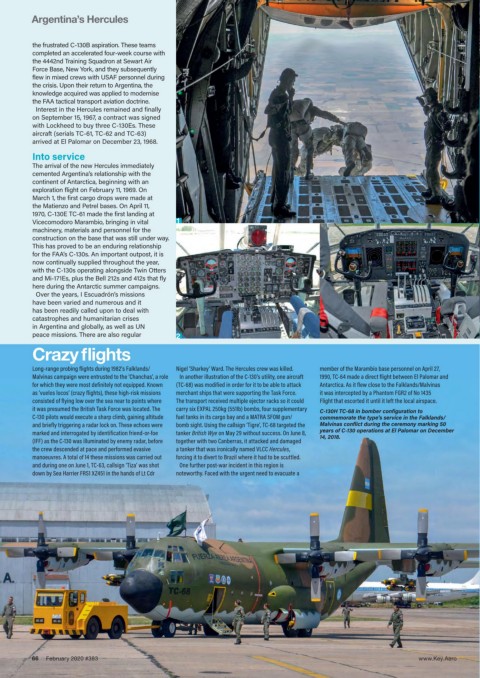
              it was presumed the British Task Force was located. The   carry six EXPAL 250kg (551lb) bombs, four supplementary   C-130H TC-68 in bomber configuration to
              C-130 pilots would execute a sharp climb, gaining altitude   fuel tanks in its cargo bay and a MATRA SFOM gun/  commemorate the type’s service in the Falklands/
              and briefly triggering a radar lock on. These echoes were   bomb sight. Using the callsign ‘Tigre’, TC-68 targeted the   Malvinas conflict during the ceremony marking 50
              marked and interrogated by identification friend-or-foe   tanker British Wye on May 29 without success. On June 8,   years of C-130 operations at El Palomar on December
                                                                                     14, 2018.
              (IFF) as the C-130 was illuminated by enemy radar, before   together with two Canberras, it attacked and damaged
              the crew descended at pace and performed evasive   a tanker that was ironically named VLCC Hercules,
              manoeuvres. A total of 14 these missions was carried out   forcing it to divert to Brazil where it had to be scuttled.
              and during one on June 1, TC-63, callsign ‘Tiza’ was shot   One further post-war incident in this region is
              down by Sea Harrier FRS1 XZ451 in the hands of Lt Cdr   noteworthy. Faced with the urgent need to evacuate a


              66 // February 2020 #383                                                                        www.Key.Aero


                                                                                                                06/01/2020   12:17:46
        64-68 ArgentineHercules AFM Feb2020.indd   66                                                           06/01/2020   12:17:46
        64-68 ArgentineHercules AFM Feb2020.indd   66

