


Page 70 - AirForces - Monthly (February 2020)
P. 70
Argentina’s Hercules


              It was clear that the FAA C-130 fleet was in   Intercontinental transpolar
             dire need of upgrade. In 2000 this became a
             very real prospect as Lockheed Martin Aircraft
             Argentina SA (LMAASA) proposed a package
             of improvements for four C-130Hs with a traffic
             collision avoidance system (TCAS) and ground-
             proximity warning system (GPWS) plus a glass
             cockpit, night-vision goggle compatibility
             as well as navigation and communications
             enhancements and a self-protection system. It
             was a plan that was, predictably, abandoned.
              A pressing need to improve the avionics in
             order to meet international standards triggered
             a project known as ‘MATE’ (Transportation
             and Liaison Aircraft Modernisation),
             which included the C-130s as well as the
             F27s, F28s and DHC-6s. This programme
             started in 2008, with the work carried out
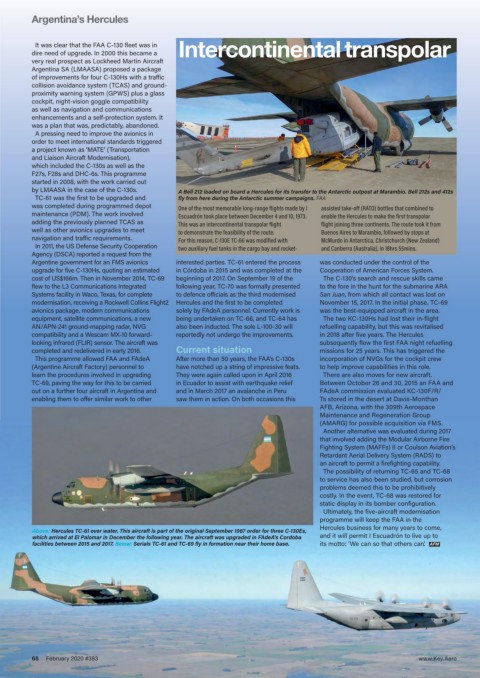
             by LMAASA in the case of the C-130s.   A Bell 212 loaded on board a Hercules for its transfer to the Antarctic outpost at Marambio. Bell 212s and 412s
              TC-61 was the first to be upgraded and   fly from here during the Antarctic summer campaigns. FAA
             was completed during programmed depot   One of the most memorable long-range flights made by I   assisted take-off (RATO) bottles that combined to
             maintenance (PDM). The work involved   Escuadrón took place between December 4 and 10, 1973.   enable the Hercules to make the first transpolar
             adding the previously planned TCAS as   This was an intercontinental transpolar flight   flight joining three continents. The route took it from
             well as other avionics upgrades to meet   to demonstrate the feasibility of the route.   Buenos Aires to Marambio, followed by stops at
             navigation and traffic requirements.   For this reason, C-130E TC-66 was modified with   McMurdo in Antarctica, Christchurch (New Zealand)
              In 2011, the US Defense Security Cooperation   two auxiliary fuel tanks in the cargo bay and rocket-  and Canberra (Australia), in 18hrs 55mins.
             Agency (DSCA) reported a request from the
             Argentine government for an FMS avionics   interested parties. TC-61 entered the process   was conducted under the control of the
             upgrade for five C-130Hs, quoting an estimated   in Córdoba in 2015 and was completed at the   Cooperation of American Forces System.
             cost of US$166m. Then in November 2014, TC-69   beginning of 2017. On September 19 of the   The C-130’s search and rescue skills came
             flew to the L3 Communications Integrated   following year, TC-70 was formally presented   to the fore in the hunt for the submarine ARA
             Systems facility in Waco, Texas, for complete   to defence officials as the third modernised   San Juan, from which all contact was lost on
             modernisation, receiving a Rockwell Collins Flight2  Hercules and the first to be completed   November 15, 2017. In the initial phase, TC-69
             avionics package, modern communications   solely by FAdeA personnel. Currently work is   was the best-equipped aircraft in the area.
             equipment, satellite communications, a new   being undertaken on TC-66, and TC-64 has   The two KC-130Hs had lost their in-flight
             AN/APN-241 ground-mapping radar, NVG   also been inducted. The sole L-100-30 will   refuelling capability, but this was revitalised
             compatibility and a Wescam MX-10 forward-  reportedly not undergo the improvements.  in 2018 after five years. The Hercules
             looking infrared (FLIR) sensor. The aircraft was                        subsequently flew the first FAA night refuelling
             completed and redelivered in early 2016.  Current situation             missions for 25 years. This has triggered the
              This programme allowed FAA and FAdeA   After more than 50 years, the FAA’s C-130s   incorporation of NVGs for the cockpit crew
             (Argentine Aircraft Factory) personnel to   have notched up a string of impressive feats.   to help improve capabilities in this role.
             learn the procedures involved in upgrading   They were again called upon in April 2016   There are also moves for new aircraft.
             TC-69, paving the way for this to be carried   in Ecuador to assist with earthquake relief   Between October 26 and 30, 2015 an FAA and
             out on a further four aircraft in Argentina and   and in March 2017 an avalanche in Peru   FAdeA commission evaluated KC-130F/R/
             enabling them to offer similar work to other   saw them in action. On both occasions this   Ts stored in the desert at Davis-Monthan
                                                                                     AFB, Arizona, with the 309th Aerospace
                                                                                     Maintenance and Regeneration Group
                                                                                     (AMARG) for possible acquisition via FMS.
                                                                                      Another alternative was evaluated during 2017
                                                                                     that involved adding the Modular Airborne Fire
                                                                                     Fighting System (MAFFs) II or Coulson Aviation’s
                                                                                     Retardant Aerial Delivery System (RADS) to
                                                                                     an aircraft to permit a firefighting capability.
                                                                                      The possibility of returning TC-65 and TC-68
                                                                                     to service has also been studied, but corrosion
                                                                                     problems deemed this to be prohibitively
                                                                                     costly. In the event, TC-68 was restored for
                                                                                     static display in its bomber configuration.
                                                                                      Ultimately, the five-aircraft modernisation
                                                                                     programme will keep the FAA in the
                                                                                     Hercules business for many years to come,
              Above: Hercules TC-61 over water. This aircraft is part of the original September 1967 order for three C-130Es,
              which arrived at El Palomar in December the following year. The aircraft was upgraded in FAdeA’s Cordoba   and it will permit I Escuadrón to live up to
              facilities between 2015 and 2017. Below: Serials TC-61 and TC-69 fly in formation near their home base.  its motto: ‘We can so that others can’ .  AFM


              68 // February 2020 #383                                                                        www.Key.Aero


                                                                                                                06/01/2020   12:18:05
        64-68 ArgentineHercules AFM Feb2020.indd   68                                                           06/01/2020   12:18:05
        64-68 ArgentineHercules AFM Feb2020.indd   68

