


Page 108 - (DK Eyewitness) Travel Guide - Belgium & Luxembourg
P. 108
106 b EL g I u M and L uxEMbou R g RE g I o n b y RE g I on
Flemish Masters
The early Flemish painters had a major impact on the history
of European art. Pioneers of oil painting on wooden panels,
they created masterpieces in the 15th century, which travelled
along trade routes, notably to Italy where artists such as
Leonardo da Vinci, stunned by their quality, in turn adopted
oil painting. Many Flemish painters subsequently absorbed
the advances of the Italian Renaissance, and the peculiarly
Flemish qualities of their art softened. Most notably, Pieter
Paul Rubens cut his teeth in Italy, then brought back an
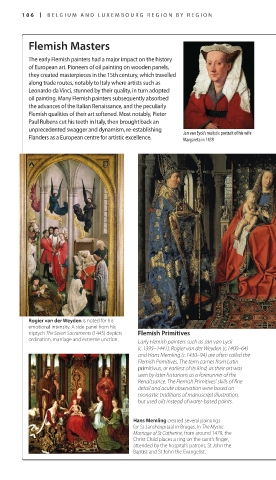
unprecedented swagger and dynamism, re-establishing Jan van Eyck’s realistic portrait of his wife
Flanders as a European centre for artistic excellence. Margareta in 1439
Rogier van der Weyden is noted for his
emotional intensity. A side panel from his
triptych The Seven Sacraments (1445) depicts Flemish Primitives
ordination, marriage and extreme unction. Early Flemish painters such as Jan van Eyck
(c.1395–1441), Rogier van der Weyden (c.1400–64)
and Hans Memling (c.1430–94) are often called the
Flemish Primitives. The term comes from Latin
primitivus, or earliest of its kind, as their art was
seen by later historians as a forerunner of the
Renaissance. The Flemish Primitives’ skills of fine
detail and acute observation were based on
monastic traditions of manuscript illustration,
but used oils instead of water-based paints.
Hans Memling created several paintings
for St-Janshospitaal in Bruges. In The Mystic
Marriage of St Catherine, from around 1479, the
Christ Child places a ring on the saint’s finger,
attended by the hospital’s patrons, St John the
Baptist and St John the Evangelist.
106-107_EW_Belgium.indd 106 16/10/14 3:32 pm
Eyewitness Travel LAYERS PRINTED:
Feature template “UK” LAYER
(SourceReport v1.3)
Date 18th October 2012
Size 125mm x 217mm

