


Page 111 - (DK Eyewitness) Travel Guide - Belgium & Luxembourg
P. 111
BEL GIUM AND L UXEMBOURG REGION B Y REGION 109
WEST AND EAST
FLANDERS
Charming, fascinating and glorying in the treasures of
its historic heritage, West and East Flanders is home to
vibrant cities such as Bruges and Ghent, and smaller towns such
as Oudenaarde, Kortrijk and Veurne. Around them lies a tranquil
rural landscape of flat or gently hilly farmland, threaded with rivers and
canals. To the north, sandy beaches face out on to the bracing North Sea.
Owing to its location at the crossroads big-game politics of Europe, battered by
of northern Europe, and to its boundary religious struggles in the 16th century as
with the North Sea, this region has often the Spanish Netherlands disintegrated,
been thrust into the forefront of historical then fought over by the Austrians, the
events. Although a Flemish-speaking land, French and the English in succeeding
it was ruled during the Middle Ages by centuries. The 20th century brought
French kings (see pp41–2) – a cause of World War I, which scored a line through
much frustration and strife. Despite this, the region, creating a wasteland on either
many of the cities, notably Bruges, Ghent, side and demolishing Ypres.
Ypres, Kortrijk and Veurne, were rich from All this changed over the latter half of
the cloth trade and industrious with crafts the 20th century with the rise of Flanders
meticulously regulated by their proud as one of Europe’s most prosperous
guilds. The Golden Age followed in the regions. The architectural treasures of the
15th century, when the dukes of Burgundy old medieval towns, sidelined and ignored
took possession and made Bruges for centuries, were restored, and the
the glittering capital of their empire. historic heritage of Flanders has become
However, between 1500 and 1945, West one of its greatest assets. Furthermore,
and East Flanders was in the doldrums. West and East Flanders has done much
The economy became largely rural, with to encourage visitors, be it in the great
small cottage industries such as lace- cities, the countryside, on the coast, or
making. The land became a pawn in the on the battlefields of the Western Front.
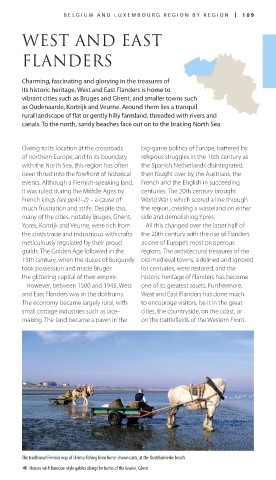
The traditional Flemish way of shrimp fishing from horse-drawn carts, at the Oostduinkerke beach
Houses with Baroque-style gables along the banks of the Graslei, Ghent
108-109_EW_Belgium.indd 109 18/10/16 3:01 pm

