


Page 131 - (DK Eyewitness) Travel Guide - Belgium & Luxembourg
P. 131
WEST AND EAST FLANDERS 129
t Kortrijk Chapel of the Counts, which
37 km (23 miles) E of Ypres. is decorated with portraits of
Road Map B2. * 80,000. £ @ the counts of Flanders. Located
n Begijnhofpark; (056) 277840. a short walk from here is the
∑ toerismekortrijk.be Begijnhof St Elisabeth, one
of Flanders’s most enchant-
A vibrant city with a historic ing béguinages.
centre, Kortrijk (Courtrai in The town’s Grote Markt has
French) owed its prominence a fine late-Gothic Stadhuis and
in medieval times to the cloth a 14th-century brick belfry
trade, and textiles still play a key whose bell is rung by gilded
role in its economy. The Battle mechanical statues. Close to
Talbot House chapel, where British soldiers of the Golden Spurs (see p42) the medieval Broeltoren – twin
gathered in Poperinge was fought near this city, and towers protecting a bridge
the museum Kortrijk 1302 over the River Leie – is the
r Poperinge explains the battle and why it is Broelmuseum, an 18th-century
an important Flemish landmark. mansion with a collection of
12 km (8 miles) W of Ieper. Road Map
A2. * 20,000. £ @ n Stadhuis, The captured spurs were paintings that includes work by
Grote Markt 1; (057) 34 66 76. ( Fri. triumphantly exhibited in the Kortrijk-born Roelandt Savery
∑ toerismepoperinge.be Onze-Lieve-Vrouwekerk until (1576–1639).
the French recovered them in In a former linen warehouse
A cloth town in medieval times, 1382. Today, this atmospheric on the banks of the Leie is the
Poperinge became a centre for church contains two notable Museum Texture, which tells
production of hops (used in treasures – The Raising of the how flax and linen played a
beer-making) in the 15th century. Cross (1631), a painting by key role in Kortrijk. River Leie
Today, this is celebrated in the Anthony van Dyck, and an was once called the “golden
Hopmuseum, an old hop alabaster statue of St Catherine river” because of all the flax
processing plant. The town (1380). The statue stands in processed in it.
centres on a Grote Markt with the spacious 14th-century
a Neo-Gothic Stadhuis built E Kortrijk 1302
in 1911. Close by is the Begijnhofpark. Tel (056) 277850.
15th-century, late-Gothic Open Tue–Sun. & 9
church, the Hoofdkerk ∑ kortrijk1302.be
St-Bertinus, which contains P Onze-Lieve-Vrouwekerk
fine woodcarving in its organ Open daily.
loft and Baroque pulpit. Its P Begijnhof St Elisabeth
tower has an unusual lantern. Open sunrise–sunset daily.
Lying some 15 km (8 miles)
behind the World War I front E Broelmuseum
line, Poperinge served as a transit Broelkaai 6. Tel (056) 277780.
point and a recuperation centre Open 2–6pm Tue–Fri, 11am–6pm
for Allied troops. Testimony of Sat, Sun & public holidays. 9
this is the Talbot House, an E Museum Texture
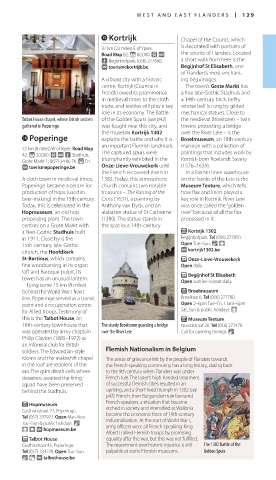
18th-century townhouse that The sturdy Broeltoren guarding a bridge Noordstraat 28. Tel (056) 277470.
was operated by army chaplain over the RIver Leie Call for opening timings. &
Philip Clayton (1885–1972) as
an informal club for British
soldiers. The Edwardian-style Flemish Nationalism in Belgium
rooms and the makeshift chapel The sense of grievance felt by the people of Flanders towards
in the roof are redolent of the the French-speaking community has a long history, dating back
era. The grim death cells where to the 9th century when Flanders was under
deserters awaited the firing French rule. The latter’s high-handed treatment
squad have been preserved of successful Flemish cities resulted in an
behind the Stadhuis. uprising, and a short-lived triumph in 1302 (see
p42). French, then Burgundian rule favoured
French-speakers, a situation that became
E Hopmuseum
Gasthuisstraat 71, Poperinge. etched in society and intensified as Wallonia
Tel (057) 337922. Open Mar–Nov: became the economic force of 19th-century
Tue–Sun & public holidays. & industrialization. At the start of World War I,
9 - ∑ hopmuseum.be army officers were all French-speaking. King
Albert I rallied Flemish troops by promising
P Talbot House equality after the war, but this was not fulfilled.
Gasthisstraat 43, Poperinge. The resentment over historic injustice is still The 1302 Battle of the
Tel (057) 333228. Open Tue–Sun. palpable at some Flemish museums. Golden Spurs
& = ∑ talbothouse.be
128-129_EW_Belgium.indd 129 18/10/16 3:01 pm

