


Page 127 - (DK Eyewitness) Travel Guide - Belgium & Luxembourg
P. 127
WEST AND EAST FLANDERS 125
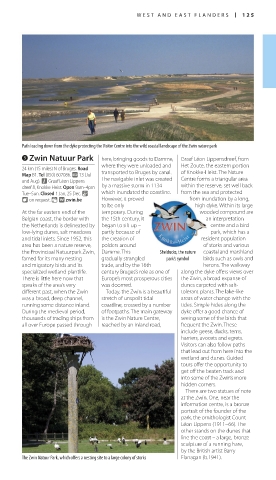
Path leading down from the dyke protecting the Visitor Centre into the wild coastal landscape of the Zwin nature park
5 Zwin Natuur Park here, bringing goods to Damme, Graaf Léon Lippensdreef, from
where they were unloaded and Het Zoute, the eastern portion
24 km (15 miles) N of Bruges. Road
Map B1. Tel (050) 607086. @ 13 (Jul transported to Bruges by canal. of Knokke-Heist. The Nature
and Aug). n Graaf Léon Lippens- The navigable inlet was created Centre forms a triangular area
dreef 8, Knokke-Heist. Open 9am–4pm by a massive storm in 1134 within the reserve, set well back
Tue–Sun. Closed 1 Jan, 25 Dec. & which inundated the coastline. from the sea and protected
8 on request. = ∑ zwin.be However, it proved from inundation by a long,
to be only high dyke. Within its large
At the far eastern end of the temporary. During wooded compound are
Belgian coast, the border with the 15th century, it an interpretation
the Netherlands is delineated by began to silt up – centre and a bird
low-lying dunes, salt meadows partly because of park, which has a
and tidal inlets. Since 1952, this the creation of resident population
area has been a nature reserve, polders around of storks and various
the Provinciaal Natuurpark Zwin, Damme. This Shelducks, the nature coastal and marshland
famed for its many nesting gradually strangled park’s symbol birds such as owls and
and migratory birds and its trade, and by the 16th herons. The walkway
specialized wetland plantlife. century Bruges’s role as one of along the dyke offers views over
There is little here now that Europe’s most prosperous cities the Zwin, a broad expanse of
speaks of the area’s very was doomed. dunes carpeted with salt-
different past, when the Zwin Today, the Zwin is a beautiful tolerant plants. The lake-like
was a broad, deep channel, stretch of unspoilt tidal areas of water change with the
running some distance inland. coastline, crossed by a number tides. Simple hides along the
During the medieval period, of footpaths. The main gateway dyke offer a good chance of
thousands of trading ships from is the Zwin Nature Centre, seeing some of the birds that
all over Europe passed through reached by an inland road, frequent the Zwin. These
include geese, ducks, terns,
harriers, avocets and egrets.
Visitors can also follow paths
that lead out from here into the
wetland and dunes. Guided
tours offer the opportunity to
get off the beaten track and
into some of the Zwin’s more
hidden corners.
There are two statues of note
at the Zwin. One, near the
information centre, is a bronze
portrait of the founder of the
park, the ornithologist Count
Léon Lippens (1911−66). The
other stands on the dunes that
line the coast – a large, bronze
sculpture of a running hare,
by the British artist Barry
The Zwin Natuur Park, which offers a nesting site to a large colony of storks Flanagan (b.1941).
124-125_EW_Belgium.indd 125 18/10/16 3:01 pm

