


Page 238 - (DK Eyewitness) Travel Guide - Belgium & Luxembourg
P. 238
236 BEL GIUM AND L UXEMBOURG REGION B Y REGION
h Château-Fort de Bouillon
Standing on a rocky plinth overlooking a loop in the River
Semois, the Château-Fort de Bouillon is of ancient origin
and is first mentioned in AD 988. The fortress was a vital
stronghold in the borderlands with France, on a route often
taken by invaders. It was home of the pious knight Godefroid
until he left for the First Crusade (1096–99). Bouillon was still
an important bastion in 1676, when it fell into the hands of
Louis XIV of France, who commissioned upgrades from his
architect Vauban. The castle survived its 15th siege in 1815
and finally ceased its military role in 1853. It is now for the
most part unfurnished, but provides a fascinating insight
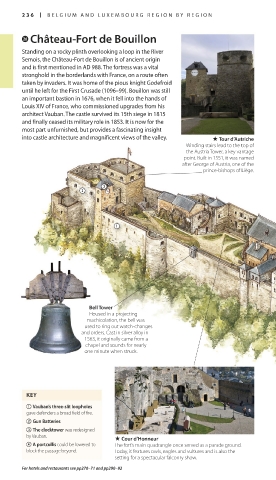
into castle architecture and magnificent views of the valley. . Tour d’Autriche
Winding stairs lead to the top of
the Austria Tower, a key vantage
point. Built in 1551, it was named
after George of Austria, one of the
prince-bishops of Liège.
Bell Tower
Housed in a projecting
machicolation, the bell was
used to ring out watch-changes
and orders. Cast in silver alloy in
1563, it originally came from a
chapel and sounds for nearly
one minute when struck.
KEY
1 Vauban’s three-slit loopholes
gave defenders a broad field of fire.
2 Gun Batteries
3 The clocktower was redesigned
by Vauban.
. Cour d’Honneur
4 A portcullis could be lowered to The fort’s main quadrangle once served as a parade ground.
block the passage beyond. Today, it features owls, eagles and vultures and is also the
setting for a spectacular falconry show.
For hotels and restaurants see pp270–71 and pp290–92
236-237_EW_Belgium.indd 236 18/10/16 2:57 pm

