


Page 316 - (DK Eyewitness) Travel Guide - Belgium & Luxembourg
P. 316
314 SUR VIV AL GUIDE
Time Difference
Belgium and Luxembourg are
on Central European Time (CET),
which is GMT + 1 (one hour
ahead of Greenwich Mean Time).
Both nations operate the same
daylight saving time over win-
ter, which means that they
move their clocks one hour for-
ward in spring (last Sunday in
March), and one hour back in
autumn (last Sunday in October).
Weights and Measures
Metric to Imperial
1 kilometre (km) = 0.62 miles
1 metre (m) = 3.28 feet (ft)
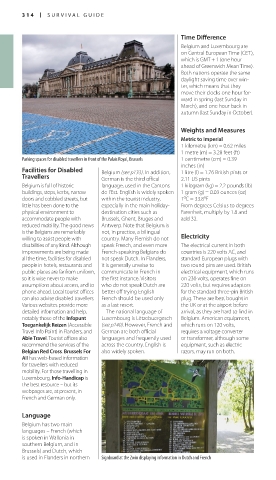
Parking spaces for disabled travellers in front of the Palais Royal, Brussels 1 centimetre (cm) = 0.39
inches (in)
Facilities for Disabled Belgium (see p133). In addition, 1 litre (l) = 1.76 British pints or
Travellers German is the third offical 2.11 US pints
Belgium is full of historic lang uage, used in the Cantons 1 kilogram (kg) = 2.2 pounds (lb)
buildings, steps, kerbs, narrow de l’Est. English is widely spoken 1 gram (g) = 0.03 ounces (oz)
doors and cobbled streets, but within the tourist indus try, 1ºC = 33.8ºF
little has been done to the especially in the main holiday- From degrees Celsius to degrees
physical environment to destination cities such as Farenheit, multiply by 1.8 and
accommodate people with Brussels, Ghent, Bruges and add 32.
reduced mobility. The good news Antwerp. Note that Belgium is
is the Belgians are remarkably not, in practice, a bilingual
willing to assist people with country. Many Flemish do not Electricity
disabilities of any kind. Although speak French, and even more The electrical current in both
improvements are being made French-speaking Belgians do countries is 220 volts AC, and
all the time, facilities for disabled not speak Dutch. In Flanders, standard European plugs with
people in hotels, restaurants and it is generally unwise to two round pins are used. British
public places are far from uniform, communicate in French in electrical equipment, which runs
so it is wise never to make the first instance. Visitors on 230 volts, operates fine on
assumptions about access, and to who do not speak Dutch are 220 volts, but requires adaptors
phone ahead. Local tourist offices better off trying English – for the standard three-pin British
can also advise disabled travellers. French should be used only plug. These are best bought in
Various websites provide more as a last resort. the UK or at the airport before
detailed information and help, The national language of arrival, as they are hard to find in
notably those of the Infopunt Luxembourg is Lëtzebuergesch Belgium. American equipment,
Toegankelijk Reizen (Accessible (see p240). However, French and which runs on 120 volts,
Travel Info Point) in Flanders, and German are both official requires a voltage converter
Able Travel. Tourist offices also languages and frequently used or transformer, although some
recommend the services of the across the country. English is equipment, such as electric
Belgian Red Cross. Brussels For also widely spoken. razors, may run on both.
All has web-based information
for travellers with reduced
mobility. For those travelling in
Luxembourg, Info-Handicap is
the best resource – but its
webpages are, at present, in
French and German only.
Language
Belgium has two main
languages – French (which
is spoken in Wallonia in
southern Belgium, and in
Brussels) and Dutch, which
is used in Flanders in northern Signboard at the Zwin displaying information in Dutch and French
314-315_EW_Belgium.indd 314 18/10/16 2:57 pm

