


Page 321 - (DK Eyewitness) Travel Guide - Belgium & Luxembourg
P. 321
PR A C TIC AL INFORM A TION 319
Currency for travellers moving across Euro- cent coins (in French, centimes)
The euro replaced the Belgian zone nations. It is also easy to are of little practical value and
franc and Luxembourg franc at handle – with notes in denomi- tend to accumulate. At the other
the beginning of 2002, and, in nations from €5 upwards, shop- end of the scale, €500 notes
contrast to some Euro-zone nations, pers are not unduly burdened are just too valuable for many
there are few regrets and little with excessive notes or change. enterprises as they are subject
nostalgia for the old currencies. Those unaccustomed to the euro to counterfeiting; many refuse
The euro currency is a blessing will discover that 1- , 2- and 5- to take €500 notes at all.
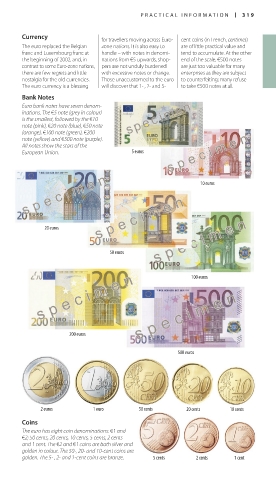
Bank Notes
Euro bank notes have seven denom-
inations. The €5 note (grey in colour)
is the smallest, followed by the €10
note (pink), €20 note (blue), €50 note
(orange), €100 note (green), €200
note (yellow) and €500 note (purple).
All notes show the stars of the
European Union. 5 euros
10 euros
20 euros
50 euros
100 euros
200 euros
500 euros
2 euros 1 euro 50 cents 20 cents 10 cents
Coins
The euro has eight coin denominations: €1 and
€2; 50 cents, 20 cents, 10 cents, 5 cents, 2 cents
and 1 cent. The €2 and €1 coins are both silver and
golden in colour. The 50-, 20- and 10-cent coins are
golden. The 5- , 2- and 1-cent coins are bronze. 5 cents 2 cents 1 cent
318-319_EW_Belgium.indd 319 18/10/16 3:03 pm

