


Page 328 - (DK Eyewitness) Travel Guide - Belgium & Luxembourg
P. 328
326 SUR VIV AL GUIDE
Getting Around the Cities Metro
The city of Brussels has a Metro
Civic pride is woven into the fabric of all municipalities in (underground) system, which
Luxembourg and Belgium, and good public access is high provides quick transport around
on the agenda. The cities and towns have grown organically the centre and to the suburbs in
as places where people live, work and play, and most still all directions. Stations are marked
by signs with a blue “M” on a
have the human scale that reflects their medieval origins. white background. Scheduled
This means that walking remains one of the best ways to get services run from 6am to mid-
around the town centres. There are also good means of public night (with shorter hours at
transport, or reasonably-priced, centrally-located car parks weekends or on pub lic holidays).
for those who drive. Brussels and Antwerp both also
have a system called PreMetro,
where the tram network travels
through extensive underground
tunnels in the city centre.
Tickets and Maps
In cities with trams or a metro
system as well as buses, tickets
are normally valid for a
continuous onward journey,
with changes, regardless of
the means of conveyance. In
Brussels, STIB tickets for bus,
tram and metro can be bought
from ticket offices and
newsagents. More economical
multi-journey cards, or one-day
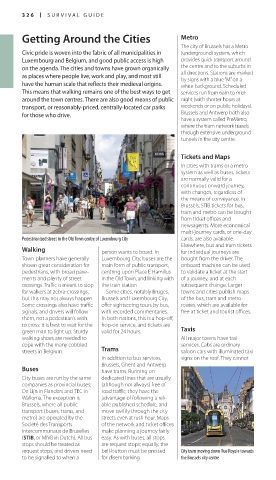
Pedestrianized street in the Old Town centre of Luxembourg City cards, are also available.
Elsewhere, bus and tram tickets
Walking person wants to board. In for individual journeys are
Town planners have generally Luxembourg City, buses are the bought from the driver. The
shown great consideration for main form of public trans port, onboard machine can be used
pedestrians, with broad pave- centring upon Place E Hamilius to validate a ticket at the start
ments and plenty of street in the Old Town, and linking with of a journey, and at each
crossings. Traffic is meant to stop the train station subsequent change. Larger
for walkers at zebra-crossings, Some cities, notably Bruges, towns and cities publish maps
but this may not always happen. Brussels and Luxembourg City, of the bus, tram and metro
Some crossings also have traffic offer sightseeing tours by bus, routes, which are available for
signals, and drivers will follow with recorded commen taries. free at ticket and tourist offices.
them, not a pedestrian’s wish In both nations, this is a hop-off,
to cross: it is best to wait for the hop-on service, and tickets are
green man to light up. Sturdy valid for 24 hours. Taxis
walking shoes are needed to All major towns have taxi
cope with the many cobbled services. Cabs are ordinary
streets in Belgium. Trams saloon cars with illuminated taxi
In addition to bus services, signs on the roof. They cannot
Brussels, Ghent and Antwerp
Buses have trams. Running on
City buses are run by the same dedi cated lines that are usually
companies as provincial buses: (although not always) free of
De Lijn in Flanders and TEC in road traffic, they have the
Wallonia. The excep tion is advantage of following a reli-
Brussels, where all public able published schedule, and
transport (buses, trams, and move swiftly through the city
metro) are operated by the streets even at rush hour. Maps
Société des Transports of the network and ticket offices
Intercommunaux de Bruxelles make planning a jour ney fairly
(STIB, or MIVB in Dutch). All bus easy. As with buses, all stops
stops should be treated as are request stops; equally, the
request stops, and drivers need bell-button must be pressed City tram moving down Rue Royale towards
to be signalled to when a for disembarking. the Brussels city centre
326-327_EW_Belgium.indd 326 18/10/16 3:03 pm
Eyewitness Travel LAYERS PRINTED:
Practical template “UK” LAYER
(Source v1.7)
Date 5th March 2013
Size 125mm x 217mm

