


Page 79 - (DK Eyewitness) Travel Guide - Belgium & Luxembourg
P. 79
brussels 77
on the combined efforts of
various well-established art
institutions in Belgium,
exploring social topics
expressed through decorative
arts, literature and music, with
influences from Theatre Royal
de la Monnaie and the
Bibliothèque royale de Belgique.
The collection of work covers
31 different European art
academies who, in 1868,
collectively created the
Société Libre des Beaux-Arts,
introducing modernism and
the avant-garde to Belgium.
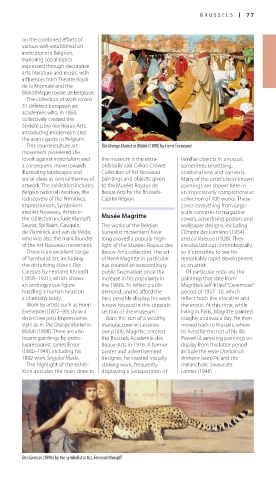
This counterculture art The Orange Market in Blidah (1898) by Henri Evenepoel
movement pioneered the
revolt against materialism and the museum is the extra- familiar objects in unusual,
a consequent move towards ordinarily vast Gillion Crowet sometimes unsettling,
illustrating landscapes and Collection of Art Nouveau combin ations and contexts.
social ideas as central themes of paintings and objects, given Many of the artist’s best-known
artwork. The exhibition includes to the Musées Royaux de paint ings are shown here in
Belgian national literature, the Beaux-Arts by the Brussels- an impressively comprehensive
rediscovery of the Primitives, Capital Region. col lection of 200 works. These
Impressionism, Symbolism cover everything from large-
and Art Nouveau. Artists in scale canvases to magazine
the collection include Khnopff, Musée Magritte covers, advertising posters and
Seurat, Spilliaert, Gauguin, The works of the Belgian wallpaper designs, including
de Vlaminick and van de Velde, Surrealist movement have L’Empire des Lumières (1954)
who was also the main founder long proved a popular high- and La Voleuse (1928). They
of the Art Nouveau movement. light of the Musées Royaux des are also laid out chronologically,
There is an excellent range Beaux-Art’s collection. The art so it’s possible to see his
of Symbolist art, including of René Magritte in particular remarkably rapid development
the disturbing classic Des has created an extraordinary as an artist.
Caresses by Fernand Khnopff public fascination since the Of particular note are the
(1858–1921), which shows increase in his popularity in paintings that date from
an androgynous figure the 1960s. To reflect public Magritte’s self-titled “Cavernous”
nuzzling a human head on demand, and to afford the period of 1927–30, which
a cheetah’s body. best possible dis play, his work reflect both the macabre and
Work by artists such as Henri is now housed in this separate the erotic. At this time, while
Evenepoel (1872–99) show a section of the museum. living in Paris, Magritte painted
distinctive post-Impressionist Born the son of a wealthy roughly a canvas a day. He then
style as in The Orange Market in manufacturer in Lessines moved back to Brussels, where
Blidah (1898). There are also (see p189), Magritte entered he lived for the rest of his life.
bizarre paintings by proto- the Brussels Academie des Powerful, arresting paintings on
Expressionist James Ensor Beaux-Arts in 1916. A former display from this latter period
(1860–1949), including his poster and advertisement include the eerie Domain of
1892 work Singular Masks. designer, he created visually Arnheim (see p74) and the
The highlight of the exhib- strik ing work, frequently melan cholic Saveur des
ition and also the main draw to displaying a juxtaposition of Larmes (1948).
Des Caresses (1896) by the symbolist artist, Fernand Khnopff
076-077_EW_Belgium.indd 77 16/10/14 3:35 pm

