


Page 108 - (DK Eyewitness) Travel Guide - Krakow
P. 108
106 KR AK OW AREA B Y AREA
wStatue of
John Paul II
Copernicus
Karol Wojtyła was born in 1920 in Pomnik Mikołaja Kopernika
Wadowice (see p162), but lived in
Krakow for many years. He arrived ul. Gołębia. Map 1 B4 (5 C3).
here in 1938 to read Polish philology v 2, 8, 13, 18. @ 504.
at the Jagiellonian University. The
outbreak of World War II put a stop to The statue of Nicolaus
his studies. During the war he worked Copernicus was made in
for the Solvay Chemical Plant and was 1900 by Cyprian Godebski.
active in the underground Rhapsody The astronomer is represented
Theatre. In 1942 he entered the as a young scholar holding
underground theological Seminary. Statue of John Paul II in an astrolabe. The statue was
As a devout priest and artists’ friend,
he became very popular. Despite his the courtyard of the originally in the courtyard of
election to the Apostolic See in 1978 his Episcopal Palace the Collegium Maius, but was
links with Krakow remained as close as ever. He continued moved to the present location
to return here with his apostolic missions on many different in front of the Witkowski
occasions, until his death in 2005. College in 1953. The statue
was intended to function
as a fountain.
0Episcopal Palace attended symbolically by
Pałac Biskupi delegations from all three
parts of the partitioned eCollegium Maius
ul. Franciszkańska 3. Map 1 C5 Poland. According to the
(5 C3). v 1, 6, 8, 13, 18, 20. contemporary records, the See pp108–9.
Closed to the public.
architect of the new building,
Feliks Księłarski, intended rCollegium
First recorded in the 13th to emulate the vernacular
century, this is one of the architecture, especially the Nowodvorianum
oldest buildings in Krakow. crystal vaults and decoration ul. Św. Anny 12. Map 1 B4 (5 C2).
It was damaged by fire and of the Collegium Maius, but Tel 12 422 04 11. v 2, 8, 13, 18.
remodelled several times. in fact he imitated German @ 504.
Giovanni Maria Mosca and Austrian models. The
contributed to the decoration. magnificent staircase is similar The Collegium Nowodvorianum
The present palace dates to the one in the Town Hall in was founded by Bartłomiej
from the times of Bishop Vienna. The college is the Nowodworski, a Knight
Piotr Tomicki (16th century) seat of the Rector of the Hospitaller of St John, Secretary
and Bishop Piotr Gembicki Jagiellonian University. It also to the King and a warrior in
(17th century). A fire in 1850 houses departmental offices, the Battle of Lepanto. This
caused extensive damage the bursary and the Great Hall foundation was a result of his
but the splendid furnishings where inauguration and bequest of 1617 to the Classes,
have partly survived. graduation ceremonies take one of the university colleges
John Paul II lived here place. The hall has a beamed and the first secular secondary
between 1964 and 1978. He and coffered ceiling, and is school in Krakow, established in
was then the Archbishop of decorated with portraits by 1586. The Collegium was built
Krakow. A statue of him, made Jan Matejko. between 1636 and 1643 by
in 1980 by Ione Sensi Croci, is
in the courtyard.
qCollegium
Novum
ul. Gołębia 24. Map 1 B4 (5 C3). Tel 12
422 10 33. v 2, 8, 13, 18. @ 504.
The Collegium Novum
replaced the Jerusalem
College after it was destroyed
by fire in the 19th century.
The ruins were demolished
between 1883 and 1887 and
the new building constructed.
Its official opening turned
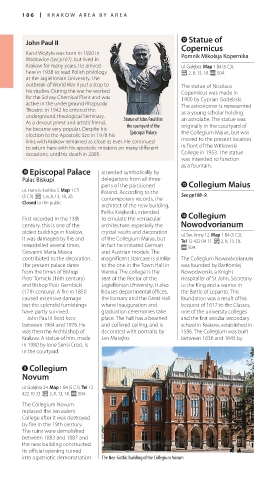
into a patriotic demonstration The Neo-Gothic building of the Collegium Novum

