


Page 109 - (DK Eyewitness) Travel Guide - Krakow
P. 109
OLD QU AR TER 107
of exhibitions by living
artists, the acquisition of
paintings and sculptures,
and the setting up of a com-
prehensive records office
gathering documents of
the history of Polish art in
the 19th and early 20th
centuries. The Art Nouveau
building was designed by
Franciszek Màczyński and
modelled on the famous
Secession Pavilion in Vienna.
The finest Krakow artists
worked on the decoration.
Jacek Malczewski designed
the frieze depicting the
vicissitudes of fortune
and the struggle of artistic
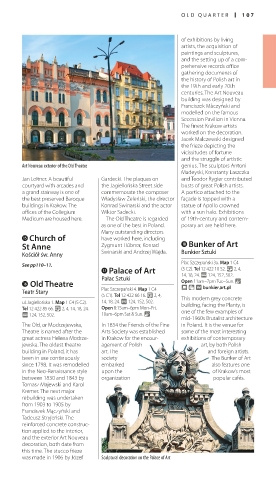
Art Nouveau exterior of the Old Theatre genius. The sculptors Antoni
Madeyski, Konstanty Laszczka
Jan Leitner. A beautiful Gardecki. The plaques on and Teodor Rygier contributed
courtyard with arcades and the Jagiellońska Street side busts of great Polish artists.
a grand stairway is one of commemorate the composer A portico attached to the
the best preserved Baroque Władysław Źeleński, the director façade is topped with a
buildings in Krakow. The Konrad Swinarski and the actor statue of Apollo crowned
offices of the Collegium Wiktor Sadecki. with a sun halo. Exhibitions
Medicum are housed here. The Old Theatre is regarded of 19th-century and contem-
as one of the best in Poland. porary art are held here.
Many outstanding directors
tChurch of have worked here, including
St Anne Zygmunt Hübner, Konrad iBunker of Art
Kościół św. Anny Swinarski and Andrzej Wajda. Bunkier Sztuki
Plac Szczepański 3a. Map 1 C4
See pp110–11.
uPalace of Art (5 C2). Tel 12 422 10 52. v 2, 4,
Pałac Sztuki 14, 18, 24. @ 124, 152, 502.
y Old Theatre Open 11am–7pm Tue–Sun. &
- = ∑ bunkier.art.pl
Teatr Stary Plac Szczepański 4. Map 1 C4
(5 C1). Tel 12 422 66 16. v 2, 4, This modern grey concrete
ul. Jagiellońska 1. Map 1 C4 (5 C2). 14, 18, 24. @ 124, 152, 502. building, facing the Planty, is
Tel 12 422 85 66. v 2, 4, 14, 18, 24. Open 8:15am–6pm Mon–Fri,
@ 124, 152, 502. 10am–6pm Sat & Sun. & one of the few examples of
mid-1960s Brutalist architecture
The Old, or Modrzejewska, In 1854 the Friends of the Fine in Poland. It is the venue for
Theatre is named after the Arts Society was established some of the most interesting
great actress Helena Modrze- in Krakow for the encour- exhibitions of contemporary
jewska. The oldest theatre agement of Polish art, by both Polish
building in Poland, it has art. The and foreign artists.
been in use continuously society The Bunker of Art
since 1798. It was remodelled embarked also features one
in the Neo-Renaissance style upon the of Krakow’s most
between 1830 and 1843 by organization popular cafés.
Tomasz Majewski and Karol
Kremer. The next major
rebuilding was undertaken
from 1903 to 1905 by
Franciszek Mączyński and
Tadeusz Stryjeński. The
reinforced concrete construc-
tion applied to the interior,
and the exterior Art Nouveau
decoration, both date from
this time. The stucco frieze
was made in 1906 by Józef Sculptural decoration on the Palace of Art

