


Page 137 - (DK Eyewitness) Travel Guide - Krakow
P. 137
WESOŁA , KLEP ARZ AND BISKUPIE 135
The church is small and has a experimental sciences gained
Greek cross groundplan. The a more prominent role in the
interior with its many columns curriculum. The suburban Jesuit
is impressive. The sumptuous residence, taken over by the
façade has elegant decoration commission after the abolition
in the late Baroque style. of the order, was rebuilt to house
The architect of the church the observatory. Stanisław
is unknown but Karol Antoni Zawadzki, the architect to King
Bay of Warsaw and Kacper Stanisław Augustus, redesigned
Bażanka are considered likely the building in an austere Neo-
to have designed it. Due to Classical style. He decorated the
the strict rule of the order, façade with astronomical signs.
the church is open to the The building is now occupied
public only during services. by the Jagiellonian Botanical
The painting on the high Institute. A modern astronomical
altar depicts Saint Theresa observatory is located in the
of Avila, to whom the church former Skała fortress in Bielany.
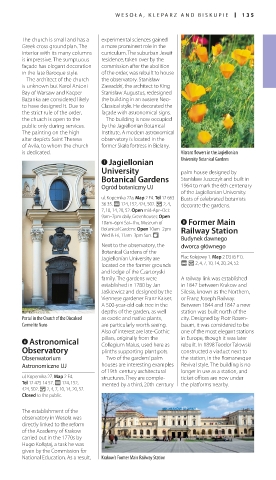
is dedicated. Vibrant flowers in the Jagiellonian
7Jagiellonian University Botanical Gardens
University palm house designed by
Botanical Gardens Stanisław Juszczyk and built in
Ogród botaniczny UJ 1964 to mark the 6th centenary
of the Jagiellonian University.
ul. Kopernika 27a. Map 2 F4. Tel 12 663 Busts of celebrated botanists
36 35. @ 124, 152, 424, 502. v 2, 4, decorate the gardens.
7, 10, 14, 20, 52. Open mid-Apr–Oct:
9am–7pm daily. Greenhouses: Open
10am–6pm Sat–Thu. Museum of 8Former Main
Botanical Gardens: Open 10am–2pm Railway Station
Wed & Fri, 11am–3pm Sun. 8
Budynek dawnego
Next to the observatory, the dworca głównego
Botanical Gardens of the
Jagiellonian University are Plac Kolejowy 1. Map 2 D3 (6 F1).
located on the former grounds @ v 2, 4, 7, 10, 14, 20, 24, 52.
and lodge of the Czartoryski
family. The gardens were A railway link was established
established in 1780 by Jan in 1847 between Krakow and
Jaśkiewicz and designed by the Silesia, known as the Northern,
Viennese gardener Franz Kaiser. or Franz Joseph Railway.
A 500-year-old oak tree in the Between 1844 and 1847 a new
depths of the garden, as well station was built north of the
Portal in the Church of the Discalced as exotic and native plants, city. Designed by Piotr Rosen-
Carmelite Nuns are particularly worth seeing. baum, it was considered to be
Also of interest are late-Gothic one of the most elegant stations
6Astronomical pillars, originally from the in Europe, though it was later
Collegium Maius, used here as
rebuilt. In 1898 Teodor Talowski
Observatory plinths supporting plant pots. constructed a viaduct next to
Obserwatorium Two of the gardens’ palm the station, in the Romanesque
Astronomiczne UJ houses are interesting examples Revival style. The building is no
of 19th-century architectural longer in use as a station, and
ul. Kopernika 27. Map 2 F4. structures. They are comple- ticket offices are now under
Tel 12 425 14 57. @ 124, 152, mented by a third, 20th-century the platforms nearby.
424, 502. v 2, 4, 7, 10, 14, 20, 52.
Closed to the public.
The establishment of the
observatory in Wesoła was
directly linked to the reform
of the Academy of Krakow
carried out in the 1770s by
Hugo Kołłątaj, a task he was
given by the Commission for
National Education. As a result, Krakow’s Former Main Railway Station

