


Page 142 - (DK Eyewitness) Travel Guide - Krakow
P. 142
140 KR AK OW AREA B Y AREA
0Grunwald years. Neo-Classicism was
Monument then applied to important
Pomnik Grunwaldzki public buildings housing
administrative and financial
Plac J Matejki. Map 2 D3 (6 E1). @ institutions, and was in sharp
154, 192, 304. v 2, 4, 7, 13, 15, 20, 24. contrast to the Functionalism
favoured in left-wing circles. The
The monument, featuring exterior sculptural decoration is
King Władysław Jagiełło on by Karol Hukan and Stanisław
horseback, was raised to mark Popławski. Inside, the domed
the 500th anniversary of the banking hall is worth a visit.
1410 victory at Grunwald
(Tannenberg in German) over
the Teutonic Knights. It was
commissioned by the states-
man, composer and pianist,
The Baroque altar of St John of Kęty in Ignacy Jan Paderewski, from
St Florian’s Church the sculptor Antoni Wiwulski.
The monument was inspired
9St Florian’s by grandiose German monu-
Church ments of the second half
Kościół św. Floriana of the 19th century. It was
generally well received but
ul. Warszawska 1B. Map 2 D3. Tel 12 some critics mocked the
422 48 42. @ 304. v 2, 4, 7, 14, 24. theatrical treatment of the
Open during services only. figures. Some even suggested
that the only lifelike figure was
In 1184 Duke Kazimierz the that of the dead Grand Master The Academy of Fine Arts in Renaissance
Just received the relics of Ulrich von Jungingen. The Revival style
St Florian from Pope Lucius III monument was destroyed by wAcademy of
and decided to deposit them the Nazis in 1939 and only
in Krakow. The horses which reconstructed in 1975 by the Fine Arts
drew the carriage carrying the sculptor Marian Konieczny. Plac J Matejki 13. Map 2 D3 (6 E1).
relics of the martyr stopped Tel 12 299 20 00. @ 304.
suddenly in Kleparz, before qNational Bank v 2, 4, 7, 14, 24.
reaching the city’s gate, and
refused to move forward. This of Poland The school of Fine Arts in
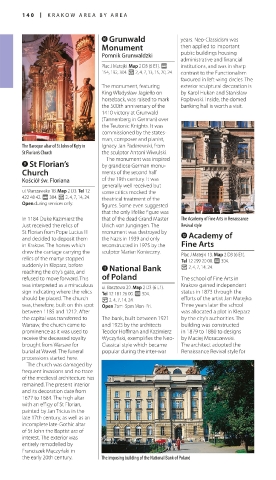
was interpreted as a miraculous ul. Basztowa 20. Map 2 D3 (6 E1). Krakow gained independent
sign indicating where the relics Tel 12 181 26 00. @ 304. status in 1873 through the
should be placed. The church v 2, 4, 7, 14, 24. efforts of the artist Jan Matejko.
was, therefore, built on this spot Open 7am–5pm Mon–Fri. Three years later the school
between 1185 and 1212. After was allocated a plot in Kleparz
the capital was transferred to The bank, built between 1921 by the city’s authorities. The
Warsaw, the church came to and 1925 by the architects building was constructed
prominence as it was used to Teodor Hoffman and Kazimierz in 1879 to 1880 to designs
receive the deceased royalty Wyczyński, exemplifies the Neo- by Maciej Moraczewski.
brought from Warsaw for Classical style which became The architect adopted the
burial at Wawel. The funeral popular during the inter-war Renaissance Revival style for
processions started here.
The church was damaged by
frequent invasions and no trace
of the medieval architecture has
remained. The present interior
and its decoration date from
1677 to 1684. The high altar
with an effigy of St Florian,
painted by Jan Tricius in the
late 17th century, as well as an
incomplete late-Gothic altar
of St John the Baptist are of
interest. The exterior was
entirely remodelled by
Franciszek Mączyński in
the early 20th century. The imposing building of the National Bank of Poland

