


Page 46 - (DK Eyewitness) Travel Guide - Krakow
P. 46
44 INTRODUCING KR AK OW
Exploring Krakow’s Museums opposite side of the Vistula,
and Galleries in Podgórze, is Schindler's
Factory, which explores the
fate of Krakow’s citizens under
Krakow’s museum collections tell the history of the city and Nazi occupation.
Polish culture in great detail. There are also a few specialized The election of the
foreign collections. A visit to all the many museums would Archbishop of Krakow, Karol
require several weeks but it is possible to concentrate on Wojtyła, to the pontificate
was an important event in
just the most important collections and still get to know the history of the city. A room
the city well. For contemporary art, head to the Museum of recreated in the Archdiocesan
Contemporary Art in Krakow (MOCAK) and the Bunker of Art. Museum commemorates
the years spent by Karol
Wojtyła in Krakow.
visitors an overview of the early
10th-century construction.
The history of the former
capital of Poland is told at
the Museum of Krakow in
Krzysztofory Palace. The
collections here include the
insignia of municipal govern-
ments and those of guilds, seals
featuring Krakow’s coat of arms
and many townscapes showing
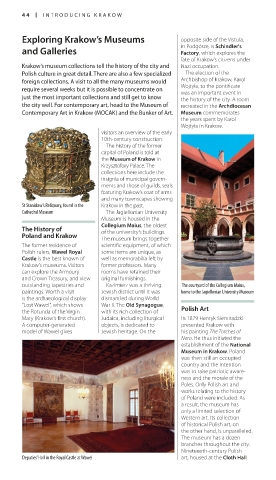
St Stanisław’s Reliquary, found in the Krakow in the past.
Cathedral Museum The Jagiellonian University
Museum is housed in the
Collegium Maius, the oldest
The History of of the university’s buildings.
Poland and Krakow The museum brings together
The former residence of scientific equipment, of which
Polish rulers, Wawel Royal some items are unique, as
Castle is the best known of well as memorabilia left by
Krakow’s museums. Visitors former professors. Many
can explore the Armoury rooms have retained their
and Crown Treasury, and view original furnishings.
outstanding tapestries and Kazimierz was a thriving The courtyard of the Collegium Maius,
paintings. Worth a visit Jewish district until it was home to the Jagiellonian University Museum
is the archaeological display dismantled during World
“Lost Wawel”, which shows War II. The Old Synagogue,
the Rotunda of the Virgin with its rich collection of Polish Art
Mary (Krakow’s first church). Judaica, including liturgical In 1879 Henryk Siemiradzki
A computer-generated objects, is dedicated to presented Krakow with
model of Wawel gives Jewish heritage. On the his painting The Torches of
Nero. He thus initiated the
establishment of the National
Museum in Krakow. Poland
was then still an occupied
country and the intention
was to raise patriotic aware-
ness and the morale of the
Poles. Only Polish art and
works relating to the history
of Poland were included. As
a result, the museum has
only a limited selection of
Western art. Its collection
of historical Polish art, on
the other hand, is unparalleled.
The museum has a dozen
branches throughout the city.
Nineteenth-century Polish
Deputies’ Hall in the Royal Castle at Wawel art, housed at the Cloth Hall

