


Page 52 - (DK Eyewitness) Travel Guide - Krakow
P. 52
50 INTRODUCING KR AK OW
Exploring Krakow’s Cemeteries
All over Europe the cult of commemorating the dead resulted
in the establishment of many large cemeteries, with beautiful
sculptures often decorating the tombs. Krakow is no different
in this respect. Numerous cemeteries and mausolea in church
crypts have been established here over the years. They were
already regarded as tourist attractions in the 19th century
and continue to be visited by those touring the city today.
The Jerzmanowski Mausoleum,
mausolea, built as chapels by Rakowicki Cemetery
Christian Cemeteries
the patrician families of Krakow,
At the end of the 18th century also survive on the former site 1914–20 and in September
a Krakovian noted that: “Every of St Mary’s Cemetery. 1939, as well as British and
time one looks through the The Rakowicki Cemetery Commonwealth airmen
window one cannot but see was established outside who lost their lives in World
graves and crosses in the centre the city in 1803 and is the War II, all rest here.
of the city.” At that time oldest cemetery in use. It The Salwator Cemetery
cemeteries used to be located occupies a vast plot and its is a far more modest place
near churches. The one at St layout is transparent. Many with no great monuments,
Mary’s was the largest. It was old trees give the place a but rather smaller tombstones
relocated at the end of the 18th park-like appearance. Some decorated with small-scale
century and the original burial tombstones, especially those but nevertheless interesting
site transformed into Mariacki made around 1900 by the bas-reliefs. It is, however,
Square. Many tombstones best Polish sculptors of the a lovely place, picturesquely
and epitaphs, often medieval, time, are true works of art. situated on a high hill and
which commemorate those In 1920 a Military rich in varied fauna. One of
who died centuries ago, have Cemetery was set up by the best times of year to visit
survived on the exterior walls the Rakowicki Cemetery (they Krakow’s cemeteries is a few
of the churches of St Mary have since merged). Polish days either side of All Saints’
and St Barbara. A number of soldiers who fell in the years Day, when they glow under
candlelight at night.
Jewish Cemeteries
For many centuries Jews
constituted a substantial
part of the population of
Kazimierz, the so-called
Jewish city. They were
interred at the Remu’h
Cemetery, established
in 1533. This small plot,
squeezed between buildings,
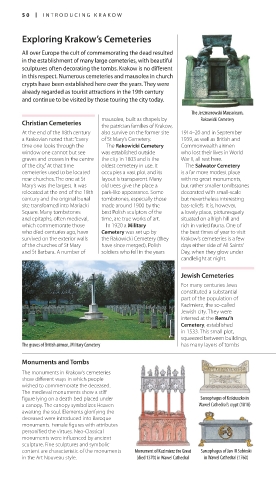
The graves of British airmen, Military Cemetery has many layers of tombs
Monuments and Tombs
The monuments in Krakow’s cemeteries
show different ways in which people
wished to commemorate the deceased.
The medieval monuments show a stiff
figure lying on a death bed placed under Sarcophagus of Kościuszko in
a canopy. The canopy symbolizes Heaven Wawel Cathedral’s crypt (1818)
awaiting the soul. Elements glorifying the
deceased were introduced into Baroque
monuments. Female figures with attributes
personified the virtues. Neo-Classical
monuments were influenced by ancient
sculpture. Fine sculptures and symbolic
content are characteristic of the monuments Monument of Kazimierz the Great Sarcophagus of Jan III Sobieski
in the Art Nouveau style. (died 1370) in Wawel Cathedral in Wawel Cathedral (1760)

