


Page 172 - (DK Eyewitness) Travel Guide - Tokyo
P. 172
170 SUR VIV AL GUIDE
Getting Around Tokyo If you travel often by bus, you
can buy a prepaid card from
Equipped to handle a daytime population swelling to well the driver or from bus sales
over 10 million every weekday, Tokyo’s public transportation offices around Tokyo.
system is remarkably diverse. Besides using the very efficient
subway system, visitors can explore the city by bus, Monorail
overground train (notably the Japan Railways Yamanote and The Tokyo Monorail starts at
Chuo lines, and the private railway lines), tram, monorail, Haneda Airport, skirts along
boat, taxi, bicycle, or even rickshaw. Buses are good for areas Tokyo Bay, and terminates at
not reached by subway or train, though the lack of English Hamamatsucho Station (on
signage can pose a difficulty. Taxis are numerous and can be the JR Yamanote Line). The
easily hired for short trips within the city. Maps are available journey takes 20 minutes.
at the Tourist Information Center (see p159). Though technically not
a monorail, the driverless
Yurikamome Line offers
fabulous views as it crosses the
Rainbow Bridge over Tokyo Bay.
You can buy a one-day Open
Pass (¥800) for unlimited travel
on this line; a combined ticket
with the Water Bus costs ¥900.
Water Bus
The most popular water bus
(suijo basu) route is the Tokyo
Cruise Ship Company, running
Sumida River Water Bus,
between Asakusa and the
“Himiko” water bus speeding along the skyscraper-lined Sumida River Hama-rikyu Gardens. Other
routes ply to various points
Green Travel Buses along the waterfront. All
Travel in Tokyo is pretty Bus companies such as services depart from Hinode
green. The superb public Keio, Toei Bus, and Tokyu Pier, close to Hinode Station
transportation network means Bus connect many parts (Yurikamome Line) and
that this is the one metropolis of Tokyo. Buses are much a 10-minute walk from
in the world where you would slower than trains and, with Hamamatsucho JR Station
feel least inclined to drive your no information in English, (Yamanote Line). Boats run
own car. Very efficient mass difficult to use for people approximately every half-hour.
transportation – albeit who do not read Japanese.
sometimes very crowded – is Buses in central Tokyo have Trams
the rule in this city, and this a flat-fare system. As you
results in a very small carbon enter, place your fare in the Tokyo’s two tramlines are
footprint per passenger mile. box beside the driver. Suica somewhat removed from
As indicated by the huge and Pasmo cards (see p173) most tourist haunts. The
numbers of bikes parked on can be used on most forms Arakawa Line (see p75) trundles
city streets, the bicycle is an of public transportation. through the backstreets of
extremely popular way of
getting around parts of Tokyo,
even though there are no cycle
paths to speak of. In fact, for
distances of up to around 6
miles (10 km), the bicycle is the
fastest way of getting around.
Eco-friendly velotaxis can be
seen in the more touristy
parts of Tokyo. In such areas,
rickshaws are also frequently an
option for those who prefer a
more leisurely and traditional
form of transportation. An
increasing number of regular
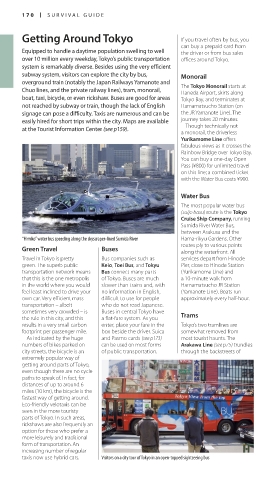
taxis now use hybrid cars. Visitors on a city tour of Tokyo in an open-topped sightseeing bus
170-171_EW_Tokyo.indd 170 12/09/16 11:29 am

