


Page 19 - (DK Eyewitness) Travel Guide - Tokyo
P. 19
A POR TR AIT OF T OK Y O 17
Traditional Architecture
Traditional Japanese architecture is based on the use of wood, combined with interiors consisting
of paper screens, paper and wood doors, and tatami mat flooring (see p110). In Tokyo’s older temples
and shrines, architectural aesthetics survive in the polished wood
floors, ceramic roof tiles, movable partitions, and the
sliding panels and opaque screens that create an
interaction between the exterior and interior. Gokoku-ji
temple (see p75), which dates from 1681, remains gloriously
intact, as does the even older Sanmon gate at Zojo-ji
temple (see p43). Though a post-war reconstruction,
the Meiji shrine (see p66), located at the centre of a sacred
forest, keeps faith with the pure, austere lines and aesthetics of
traditional Shinto architecture.
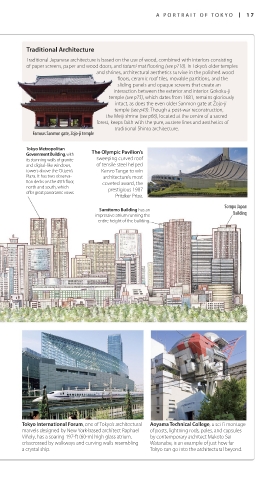
Famous Sanmon gate, Zojo-ji temple
Tokyo Metropolitan
Government Building, with The Olympic Pavilion’s
its stunning walls of granite sweeping curved roof
and digital-like windows, of tensile steel helped
towers above the Citizen’s Kenzo Tange to win
Plaza. It has two observa- architecture’s most
tion decks on the 45th floor, coveted award, the
north and south, which prestigious 1987
offer great panoramic views.
Pritzker Prize.
Sompo Japan
Sumitomo Building has an
impressive atrium running the Building
entire height of the building.
Tokyo International Forum, one of Tokyo’s architectural Aoyama Technical College, a sci-fi montage
marvels designed by New York-based architect Raphael of posts, lightning rods, poles, and capsules
Viñoly, has a soaring 197-ft (60-m) high glass atrium, by contemporary architect Makoto Sei
crisscrossed by walkways and curving walls resembling Watanabe, is an example of just how far
a crystal ship. Tokyo can go into the architectural beyond.
016-017_EW_Tokyo.indd 17 12/09/16 11:27 am

