


Page 20 - (DK Eyewitness) Travel Guide - Tokyo
P. 20
18 INTRODUCING T OK Y O
Japanese Traditional Theater
Four major types of traditional theater are still performed
regularly in Japan – Noh, Kyogen, Kabuki, and Bunraku (see
pp150–51). Originating in Shinto rites, Noh was first performed
by Kan’ami Kiyotsugu (1333–84) and developed by his son
Zeami. Adopted by the daimyo (feudal lords), Noh became more
ritualistic and ceremonial. Gradually its farcical elements were
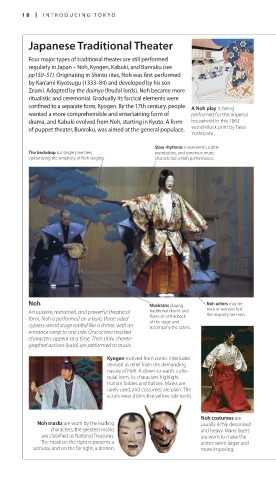
confined to a separate form, Kyogen. By the 17th century, people A Noh play is being
wanted a more compre hensible and entertaining form of performed for the imperial
drama, and Kabuki evolved from Noh, starting in Kyoto. A form household in this 1863
of puppet theater, Bun raku, was aimed at the general populace. wood-block print by Taiso
Yoshitoshi.
Slow rhythmic movements, subtle
The backdrop is a single pine tree, expressions, and sonorous music
epitomizing the simplicity of Noh staging. characterize a Noh performance.
Noh Musicians playing Noh actors may be
An austere, restrained, and powerful theatrical traditional drums and men or women but
the majority are men.
form, Noh is performed on a bare, three-sided flutes sit at the back
of the stage and
cypress-wood stage roofed like a shrine, with an accompany the actors.
entrance ramp to one side. One or two masked
characters appear at a time. Their slow, choreo-
graphed actions (kata) are performed to music.
Kyogen evolved from comic interludes
devised as relief from the demanding
nature of Noh. A down-to-earth, collo-
quial form, its characters highlight
human foibles and frailties. Masks are
rarely used, and costumes are plain. The
actors wear distinctive yellow tabi socks.
Noh costumes are
Noh masks are worn by the leading usually richly deco rated
characters; the greatest masks and heavy. Many layers
are classified as National Treasures. are worn to make the
The mask on the right represents a actors seem larger and
samurai, and on the far right, a demon. more imposing.
018-019_EW_Tokyo.indd 18 12/09/16 11:27 am

