


Page 47 - (DK Eyewitness) Travel Guide - Tokyo
P. 47
CENTR AL T OK Y O 45
9 Tokyo q Imperial Palace
International Imperial Palace
Forum Map 3 A5, 3 B5, 5 A1, 5 B1.
Nijubashi stn, Chiyoda line. £ Tokyo
Tokyo International Forum
stn, many lines. Imperial Palace:
Map 5 B2. Yurakucho stn, Open Jan 2, Dec 23. East Garden of the
Yurakucho line; Tokyo stn, Maru nouchi Imperial Palace: Tel (03) 3213-1111.
line. £ Tokyo & Yurakucho stns, many Open 9am–4:30pm Tue–Thu, Sat, Sun
lines. Open 7am–10:30pm daily. (Nov–Feb: to 4pm). Closed Mon, Fri.
∑ t-i-forum.co.jp/en
Ieyasu, the first Tokugawa
Designed by New York-based shogun, started building his
architect Rafael Viñoly, and castle here in 1590. In the Edo
completed in 1996, the Forum is period his successors made this
one of downtown Tokyo’s most The imposing granite exterior of the into the world’s largest castle;
distinctive buildings (see p17). Diet Building now only the inner circle
A cultural center, it is made up remains. The emperor and his
of two buildings – a curved, 0 The Diet family still live in the western
glass atrium soaring 200 ft Building part of the grounds in the
(60m), and a cube-like, white Imperial Palace, rebuilt after
the previous one was bombed
structure housing four halls Hibiya District and the Diet Building
(the largest seating 5,012). A Map 2 F3, 5 A2, 5 B2. Kokkai- during World War II. Public access
tree-shaded courtyard separates Gijidomae stn, Chiyoda & Marunouchi is allowed twice a year – at
the two, while glass walkways lines; Hibiya stn, Toei Mita, Chiyoda & New Year and on the emperor’s
provide an overhead link. Hibiya lines. Diet Building: Open birthday. The rest of the grounds,
The interior of the huge 9am–5pm Mon–Fri. 8 (compulsory, bounded by the moat, are
atrium has a ceiling resem bling by reserva tion). Idemitsu Museum of divided into public parks.
a ship’s hull. Inside the Forum Arts: Tel (03) 5777-8600. Open The most famous landmark is
10am–5pm Tue–Sun (to 7pm Fri).
are a number of shops, cafés, Hibiya Park: Open 24 hrs daily. the Nijubashi, a double-arched
and restaurants, all with state- ∑ sangiin.go.jp/eng/index.htm stone bridge, east of the palace.
of-the-art facilities. The Cultural Completed in 1888, it was the
Information Lobby within the Comple ted in 1936, the palace’s main en trance. The
complex offers Internet facili ties Diet Building houses the huge Otemon (Big Hand Gate),
and has an audio-visual library legislature of the Japanese rebuilt in 1967, was the main
high lighting Tokyo’s attractions. government, originally gate before Niju bashi was
establish ed as the built. Now it is the entrance
Imperial Diet in the to the East Garden of the
Meiji era. Tours (in Imperial Palace. Just inside
Japanese only) cover is Sannomaru Shozo kan, a
the Diet chamber, collection of art and artifacts
where you can see of the Showa Emperor. Beyond
the deliberations of is the Edo-era Hyaku nin Basho,
Diet members, and where 100 samurai lived while
the extrava gantly deco- standing guard in shifts. Behind
rated rooms used by the is the Honmaru, the castle’s
emperor for official main keep, only massive stone
functions. Overlooking walls remain with good views
the Imperial Palace, in from the top. To the east of the
the Tei Geki building, the Honmaru is the Nino maru
Idemitsu Museum of garden, land scaped by
Arts features one of the Shogun Iemitsu in 1630.
city’s finest displays of
Japanese and Asian art.
Nearby is Central
Tokyo’s only Western-
style park, Hibiya Park,
which is the focus of
Hibiya district. The
park’s location, close
to political centers,
makes it a favorite
place for public protests.
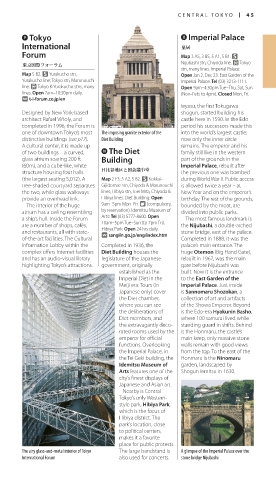
The airy glass-and-metal interior of Tokyo The large bandstand is A glimpse of the Imperial Palace over the
International Forum also used for concerts. stone bridge Nijubashi
044-045_EW_Tokyo.indd 45 12/09/16 11:27 am

