


Page 68 - (DK Eyewitness) Travel Guide - Tokyo
P. 68
66 T OK Y O AREA B Y AREA
either return to the Otorii and
turn left, following the signs,
or walk through the woods
to the left of the shrine. Lining
the walls of the single high-
vaulted room of the Treasure
Museum are portraits of every
emperor going back more
than 1,000 years. Objects on
display include the gorgeous
kimonos worn by Emperor
Meiji and Empress Shoken
for court functions.
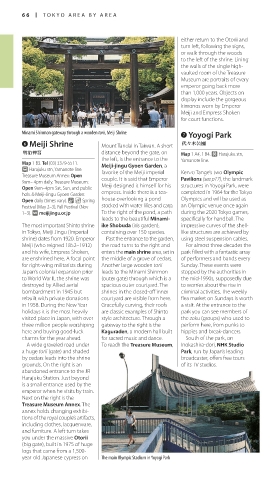
Minami Shinmon gateway through a wooden torii, Meiji Shrine 7 Yoyogi Park
6 Meiji Shrine Mount Tandai in Taiwan. A short Yoyogi Park
distance beyond the gate, on
Meiji Shrine Map 1 A4, 1 B4. £ Harajuku stn,
the left, is the entrance to the Yamanote line.
Map 1 B3. Tel (03) 3379-5511. Meiji-jingu Gyoen Garden, a
£ Harajuku stn, Yamanote line. favorite of the Meiji imperial Kenzo Tange’s two Olympic
Treasure Museum Annex: Open
9am– 4pm daily. Treasure Museum: couple. It is said that Emperor Pavilions (see p17), the landmark
Open 9am–4pm Sat, Sun, and public Meiji designed it him self for his structures in Yoyogi Park, were
hols. & Meiji-Jingu Gyoen Garden: empress. Inside there is a tea- completed in 1964 for the Tokyo
Open daily (times vary). & _ Spring house over looking a pond Olympics and will be used as
Festival (May 2–3), Fall Festival (Nov stocked with water lilies and carp. an Olympic venue once again
1–3). ∑ meijijingu.or.jp To the right of the pond, a path during the 2020 Tokyo games,
leads to the beautiful Minami- specifically for handball. The
The most important Shinto shrine ike Shobuda (iris garden), impressive curves of the shell-
in Tokyo, Meiji Jingu (Imperial contain ing over 150 species. like structures are achieved by
shrine) dates from 1920. Emperor Past the entrance to the garden, using steel suspension cables.
Meiji (who reigned 1852–1912) the road turns to the right and For almost three decades the
and his wife, Empress Shoken, enters the main shrine area, set in park filled with a fantastic array
are enshrined here. A focal point the middle of a grove of cedars. of performers and bands every
for right-wing militarists during Another large wooden torii Sunday. These events were
Japan’s colonial expansion prior leads to the Minami Shinmon stopped by the authorities in
to World War II, the shrine was (outer gate) through which is a the mid-1990s, supposedly due
destroyed by Allied aerial spacious outer courtyard. The to worries about the rise in
bombardment in 1945 but shrines in the closed-off inner criminal activities. The weekly
rebuilt with private donations courtyard are visible from here. flea market on Sundays is worth
in 1958. During the New Year Gracefully curving, their roofs a visit. At the entrance to the
holidays it is the most heavily are classic examples of Shinto park you can see memb ers of
visited place in Japan, with over style architecture. Through a the zoku (groups) who used to
three million people worshiping gateway to the right is the perform here, from punks to
here and buying good-luck Kaguraden, a modern hall built hippies and break-dancers.
charms for the year ahead. for sacred music and dance. South of the park, on
A wide graveled road under To reach the Treasure Museum, Inokashira-dori, NHK Studio
a huge torii (gate) and shaded Park, run by Japan’s leading
by cedars leads into the shrine broadcaster, offers free tours
grounds. On the right is an of its TV studios.
abandoned entrance to the JR
Harajuku Station. Just beyond
is a small entrance used by the
emperor when he visits by train.
Next on the right is the
Treasure Museum Annex. The
annex holds changing exhibi-
tions of the royal couple’s artifacts,
including clothes, lacquer ware,
and furniture. A left turn takes
you under the massive Otorii
(big gate), built in 1975 of huge
logs that came from a 1,500-
year-old Japanese cypress on The main Olympic Stadium in Yoyogi Park
066-067_EW_Tokyo.indd 66 12/09/16 11:23 am

