


Page 73 - (DK Eyewitness) Travel Guide - Tokyo
P. 73
WESTERN T OK Y O 71
the main rendezvous spot to social ize. Limousines carry
in Roppongi. The area to the dark-blue-suited men to the
south is where the action is. many exclusive establishments
Clubs come in all shapes and lining the streets here.
sizes, some just wide enough About 656 ft (200 m) along
for a counter and stools. Check Aoyama-dori from Akasaka
the prices of drinks as they Mitsuke Station is the Toyo-
vary hugely. Just a couple of kawa Inari Shrine (also called
blocks north of Roppongi Myogon-ji). With its red lanterns
crossing lies the long-running and flags, and dozens of statues
institution Satin Doll. This of foxes (the messengers of
classy restaurant offers Inari, a Shinto rice deity), this
world-class jazz acts and is a pleasant place to linger
sophisticated French cuisine. for a while.
To the north of Almond lies Going back past Akasaka
the complex known as Tokyo Mitsuke Station and over the
Midtown, which houses the moat leads to a large building
Suntory Museum of Art. The that some may recognize from
Entrance to the contemporary Mori Art museum has an unrivaled the James Bond film You Only
Museum, Roppongi collection of Edo-era screens, Live Twice. This is the luxurious
depicting scenes from the Edo Hotel New Otani. On the 17th
This is also the place for big- court; one particularly fine floor is the revolving THE
name inter national restaurant example is Namban Sky restaurant, serving
chains such as the Hard Rock (Westerners in Chinese food and
Café, Spago, and Tony Roma’s. Japan). Traditional offering stunning
Unveiled in 2003, Roppongi decorative arts are views across central
Hills aspires to be an all- also well represented Tokyo and the
purpose mini-city. The 54-story here, with ceramics, Imperial Palace. In
Mori Tower forms the focus of lacquer ware, textiles, Ironware kettle in the the vast grounds
the hills. Over 200 shops, and tea utensils. There Suntory Museum of Art and open to all is
restaurants, and bars occupy is also a tea ceremony a 17th-century
the complex, which also boasts room, café, and a museum shop. Japanese garden.
cinemas, interconnecting South of Akasaka-Mitsuke
walkways, the Grand Hyatt w Akasaka District Station is the Hie Jinja, a
Tokyo (see p112), and the richly shrine that was erected
imag inative and daring exhibits Akasaka District
in 1478. Shogun Ietsuna
of the Mori Art Museum. Map 2 E3–4, 2 F3–4. Akasaka- moved it here in the 17th
Ad mis sion to the museum Mitsuke stn, Ginza & Marunouchi lines; century to buffer his castle;
includes access to the Tokyo Nagatacho stn, Yurakucho, Namboku the present-day buildings
City View, a 52nd-floor & Hanzomon lines. _ Sanno Matsuri are all modern. Each year in
observation deck (open later (Jun 16, Hie Jinja). mid-June the Sanno Matsuri
than the museum). Maman, the is celebrated here with a
giant, spiny, spider sculpture by With the Diet Building (see p45) grand procession of 50
Louise Bourgeois outside the and many government offices Mikoshi (portable shrines)
main tower, is a major draw. just to the east, Akasaka is a and people in Heian-era
The National Art Center is favorite place for politicians costumes (see pp30–32).
part of an effort to reinvent
Roppongi as some thing more
than just a night life zone. The
work of re nowned architect
Kisho Kurokawa, the rippling
facade of the building is based
on computer- generated
rhythmic images inspired by
waves and hills. The largest
exhibition space in Japan, the
art center does not have a
permanent collection of its
own, but re gularly features
prominent Japanese as well as
overseas exhibitions. Almond
(Amando in Japanese), at the
inter section of Roppongi-dori
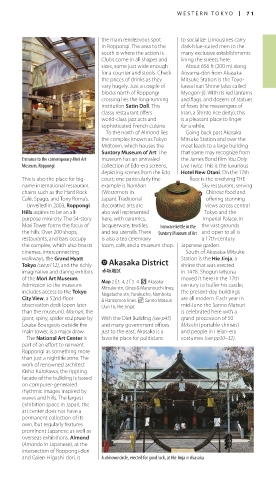
and Gaien-Higashi-dori, is A chinowa circle, erected for good luck, at Hie Jinja in Akasaka
070-071_EW_Tokyo.indd 71 12/09/16 11:27 am

