


Page 66 - MotorTrend (March 2020)
P. 66
brakes. Then a 200-mph run using max
                                                         power without reheat—the afterburner—
                                                         and a coast-down to establish rolling
                                                         resistance. And finally, a 350-mph run
                                                         using full reheat—Bloodhound thundering
                                                         from 50 to 300 mph in 13 seconds—with
                                                         stability tests before and after peak speed,
                                                         then a coast-down after engine shutdown
                                                         to measure rolling resistance without
                                                         the jet engine’s idle thrust. This run also
                                                         allowed to team to collect data on para-
                                                         chute deployment.
                                                           Finally, it’s the morning of November 16.
                                                         Sunny, the temperature a mild 77 degrees,
                                                         winds no more than 3 to 6 mph. Green
                                                         straps in for Run 34. A white line runs
                                                         from under Bloodhound’s low-slung nose
                                                         straight across the baked brown crust to
                                                         the far horizon. Green throttles up then
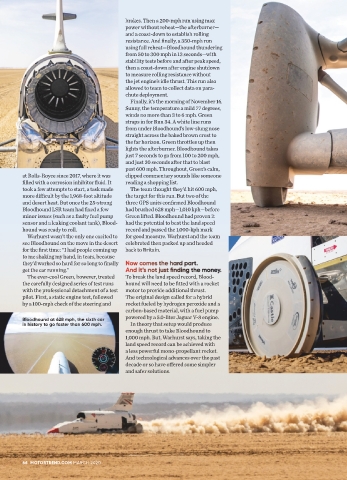
                                                         lights the afterburner. Bloodhound takes
                                                         just 7 seconds to go from 100 to 200 mph,
                                                         and just 30 seconds after that to blast
                                                         past 600 mph. Throughout, Green’s calm,
           at Rolls-Royce since 2017, where it was       clipped commentary sounds like someone
           filled with a corrosion inhibitor fluid. It     reading a shopping list.
           took a few attempts to start, a task made       The team thought they’d hit 600 mph,
           more difficult by the 1,968-foot altitude      the target for this run. But two of the
           and desert heat. But once the 25-strong       three GPS units confirmed Bloodhound
           Bloodhound LSR team had fixed a few            had brushed 628 mph—1,010 kph—before
           minor issues (such as a faulty fuel pump      Green lifted. Bloodhound had proven it
           sensor and a leaking coolant tank), Blood-    had the potential to beat the land speed
           hound was ready to roll.                      record and passed the 1,000-kph mark
             Warhurst wasn’t the only one excited to     for good measure. Warhurst and the team
           see Bloodhound on the move in the desert      celebrated then packed up and headed
           for the first time: “I had people coming up    back to Britain.
           to me shaking my hand, in tears, because
           they’d worked so hard for so long to finally
           get the car running.”
             The ever-cool Green, however, treated       To break the land speed record, Blood-
           the carefully designed series of test runs    hound will need to be fitted with a rocket
           with the professional detachment of a test    motor to provide additional thrust.
           pilot. First, a static engine test, followed   The original design called for a hybrid
           by a 100-mph check of the steering and        rocket fueled by hydrogen peroxide and a
                                                         carbon-based material, with a fuel pump
                                                         powered by a 5.0-liter Jaguar V-8 engine.
           Bloodhound at 628 mph, the sixth car
           in history to go faster than 600 mph.           In theory that setup would produce
                                                         enough thrust to take Bloodhound to
                                                         1,000 mph. But, Warhurst says, taking the
                                                         land speed record can be achieved with
                                                         a less powerful mono-propellant rocket.
                                                         And technological advances over the past
                                                         decade or so have offered some simpler
                                                         and safer solutions.


           66  MOTORTREND.COM MARCH 2020

