


Page 105 - Forbes - USA (February 2018)
P. 105
tween these extremes, between starva-
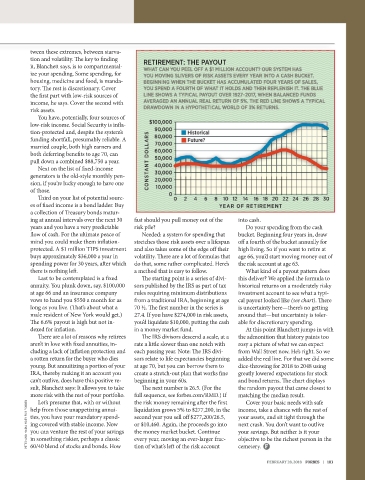
           tion and volatility. The key to fi nding   RETIREMENT: THE PAYOUT

           it, Blanchett says, is to compartmental-  WHAT CAN YOU PEEL OFF A $1 MILLION ACCOUNT? OUR SYSTEM HAS
           ize your spending. Some spending, for   YOU MOVING SLIVERS OF RISK ASSETS EVERY YEAR INTO A CASH BUCKET.
           housing, medicine and food, is manda-  BEGINNING WHEN THE BUCKET HAS ACCUMULATED FOUR YEARS OF SALES,

           tory. The rest is discretionary. Cover   YOU SPEND A FOURTH OF WHAT IT HOLDS AND THEN REPLENISH IT. THE BLUE
           the first part with low-risk sources of   LINE SHOWS A TYPICAL PAYOUT OVER 1927–2017, WHEN BALANCED FUNDS

           income, he says. Cover the second with   AVERAGED AN ANNUAL REAL RETURN OF 5%. THE RED LINE SHOWS A TYPICAL
                                              DRAWDOWN IN A HYPOTHETICAL WORLD OF 3% RETURNS.
           risk assets.
             You have, potentially, four sources of
                                                $100,000
           low-risk income. Social Security is infl a-
           tion-protected and, despite the system’s   90,000  Historical
           funding shortfall, presumably reliable. A   80,000  Future?
           married couple, both high earners and   70,000

           both deferring benefits to age 70, can   60,000
           pull down a combined $88,750 a year.  CONSTANT DOLLARS  50,000
                                                  40,000
             Next on the list of fi xed-income
           generators is the old-style monthly pen-  30,000
                                                  20,000
           sion, if you’re lucky enough to have one   10,000
           of those.
                                                      0

             Third on your list of potential sourc-     0     2     4     6     8    10   12    14    16   18   20   22   24   26   28   30

           es of fixed income is a bond ladder. Buy                   YEAR OF RETIREMENT
           a collection of Treasury bonds matur-
           ing at annual intervals over the next 30   fast should you pull money out of the   into cash.
           years and you have a very predictable   risk pile?                  Do your spending from the cash
           flow of cash. For the ultimate peace of   Needed: a system for spending that   bucket. Beginning four years in, draw


           mind you could make them infl ation-  stretches those risk assets over a lifespan   off a fourth of the bucket annually for
           protected. A $1 million TIPS investment   and also takes some of the edge off  their   high living. So if you want to retire at
           buys approximately $36,000 a year in   volatility. There are a lot of formulas that   age 66, you’d start moving money out of

           spending power for 30 years, aft er which   do that, some rather complicated. Here’s   the risk account at age 63.
           there is nothing left .         a method that is easy to  follow.   What kind of a payout pattern does
             Last to be contemplated is a fi xed   The starting point is a series of divi-  this deliver? We applied the formula to

           annuity. You plunk down, say, $100,000   sors published by the IRS as part of tax   historical returns on a moderately risky
           at age 66 and an insurance company   rules requiring minimum distributions   investment account to see what a typi-
           vows to hand you $550 a month for as   from a traditional IRA, beginning at age   cal payout looked like (see chart). Th ere
           long as you live. (That’s about what a   70 ½. Th e first number in the series is   is uncertainty here—there’s no getting


           male resident of New York would get.)   27.4. If you have $274,000 in risk assets,   around that—but uncertainty is toler-

           The 6.6% payout is high but not in-  you’d liquidate $10,000, putting the cash   able for discretionary spending.
           dexed for infl ation.           in a money market fund.             At this point Blanchett jumps in with

             There are a lot of reasons why retirees   The IRS divisors descend a scale, at a   the admonition that history paints too


           aren’t in love with fixed annuities, in-  rate a little slower than one notch with   rosy a picture of what we can expect

           cluding a lack of inflation protection and   each passing year. Note: The IRS divi-  from Wall Street now. He’s right. So we

           a rotten return for the buyer who dies   sors relate to life expectancies beginning   added the red line. For that we did some
           young. But annuitizing a portion of your   at age 70, but you can borrow them to   dice-throwing for 2018 to 2048 using
           IRA, thereby making it an account you   create a stretch-out plan that works fi ne   greatly lowered expectations for stock
           can’t outlive, does have this positive re-  beginning in your 60s.  and bond returns. The chart displays

           sult, Blanchett says: It allows you to take   The next number is 26.5. (For the   the random payout that came closest to

           more risk with the rest of your portfolio.  full sequence, see forbes.com/RMD.) If   matching the median result.
             Let’s presume that, with or without
                                                                               Cover your basic needs with safe
          PETER AND MARIA HOEY FOR FORBES  help from those unappetizing annui-  liquidation grows 5% to $277,200, in the   income, take a chance with the rest of
                                           the risk money remaining after the fi rst

           ties, you have your mandatory spend-
                                           second year you sell off  $277,200/26.5,
                                                                            your assets, and sit tight through the
           ing covered with stable income. Now
                                                                            next crash. You don’t want to outlive
                                           or $10,460. Again, the proceeds go into
                                                                            your savings. But neither is it your
                                           the money market bucket. Continue
           you can venture the rest of your savings
           in something riskier, perhaps a classic
                                                                            objective to be the richest person in the
                                           every year, moving an ever-larger frac-
           60/40 blend of stocks and bonds. How

                                           tion of what’s left of the risk account
                                                                            cemetery. F
                                                                                     FEBRUARY 28, 2018     FORBES     |     103

