


Page 39 - World of Animals - Issue #28 Magazine
P. 39
The importance
                                                               The tropical                     of ecotourism
                                                            equatorial rainforest
                                                            receives around 160-                Justin Wateridge is managing director of Steppes
                                                            200 centimetres (63-                Travel, a luxury travel provider that can take you
                                                            79 inches) of rainfall              to explore the Congo in all its glory without leaving
                                                             per year, much of      a bad mark on the ecosystem. He talks to us about how being an
                                                            which falls during the   ecotourist can make all the difference.
                                                               rainy season.
                                                                                    What is ecotourism?
                                                                                    Ecotourism is simply described as sustainable travel to natural areas
                                                                                    that works to conserve the environment, sustain the wellbeing of the
                                                                                    local people living and working there and involves emphasis upon
                                                                                    interpretation and education for the travellers and visitors.

                                                                                    How does this benefit the rainforest ecosystem?
                                                                                    The rainforest benefits because the practice of ecotourism places
                                                                                    a high value on the forest as opposed to logging and other such
                                                                                    extractive (and very destructive) industries. Another benefit is that
                                                                                    the encouragement of conscientious travellers can bring revenue
                                                                                    and employment to local and indigenous peoples. Ecotourism can
                                                                                    also bring much-needed revenue to conservation agencies and
                                                                                    researchers who do essential work in managing and preserving the
                                                                                    forest ecosystem.

                                                                                    What kind of things can ecotourists do when visiting?
                                                                                    When you take a trip to the rainforest of the Congo River Basin
                                                                                    (and beyond), as an ecotourist you can see the wildlife in its natural
                                                                                    habitat and visit some of the incredible local communities that live in
                                                                                    the rainforest. In a forest such as in the Congo, the amazing wildlife
                                                                                    that lives there would include forest elephants, lowland gorillas
                                                                                    and sitatunga (a swamp-dwelling antelope) – fantastic creatures to
                                                                                    witness in the wild.

                                                                                    Is there an ecotourism code of conduct?
                                                                                    There is no one particular code. However, there are various bodies
                                                                                    that advocate best practice for tour operators and tourists alike,
                                                                                    such as respecting local communities and customs, not interfering
                                                                                    with wildlife, keeping to paths to protect the environment, eating and
                                                                            ABOVE   drinking locally and protecting local resources.
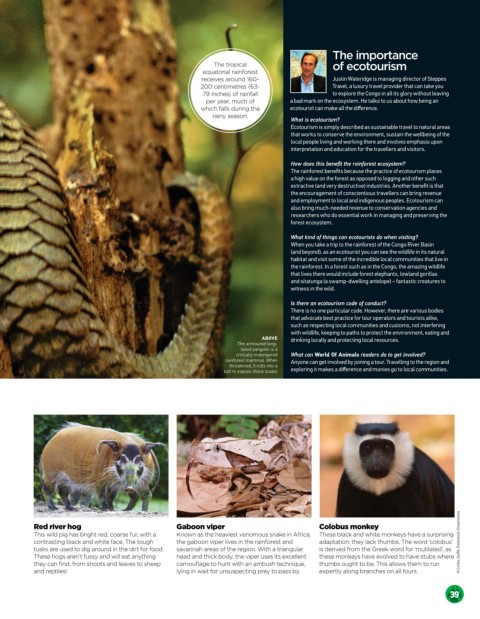
                                                                      The armoured long-
                                                                       tailed pangolin is a
                                                                     critically endangered   What can World Of Animals readers do to get involved?
                                                                  rainforest mammal. When   Anyone can get involved by joining a tour. Travelling to the region and
                                                                    threatened, it rolls into a
                                                                  ball to expose sharp scales  exploring it makes a difference and monies go to local communities.


              Red river hog                          Gaboon viper                           Colobus monkey
              This wild pig has bright red, coarse fur, with a   Known as the heaviest venomous snake in Africa,   These black and white monkeys have a surprising
              contrasting black and white face. The tough   the gaboon viper lives in the rainforest and   adaptation: they lack thumbs. The word ‘colobus’  © Corbis; Sol90; Thinkstock; Dreamstime
              tusks are used to dig around in the dirt for food.   savannah areas of the region. With a triangular   is derived from the Greek word for ‘mutilated’, as
              These hogs aren’t fussy and will eat anything   head and thick body, the viper uses its excellent   these monkeys have evolved to have stubs where
              they can find, from shoots and leaves to sheep   camouflage to hunt with an ambush technique,   thumbs ought to be. This allows them to run
              and reptiles!                          lying in wait for unsuspecting prey to pass by.  expertly along branches on all fours.

                                                                                                                               39

