


Page 38 - World of Animals - Issue #28 Magazine
P. 38
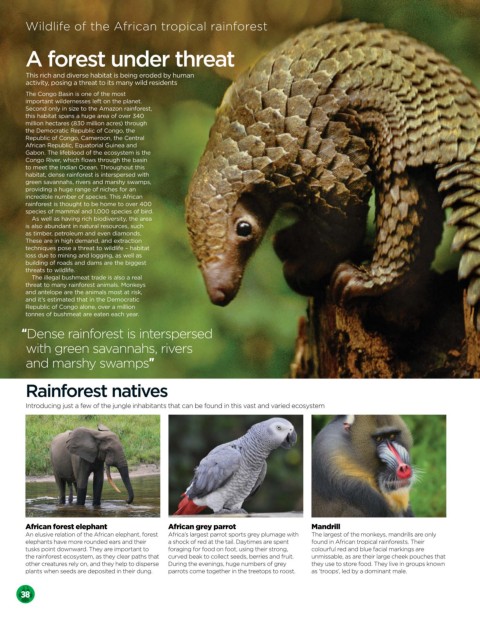
Wildlife of the African tropical rainforest


            A forest under threat


            This rich and diverse habitat is being eroded by human
            activity, posing a threat to its many wild residents
            The Congo Basin is one of the most
            important wildernesses left on the planet.
            Second only in size to the Amazon rainforest,
            this habitat spans a huge area of over 340
            million hectares (830 million acres) through
            the Democratic Republic of Congo, the
            Republic of Congo, Cameroon, the Central
            African Republic, Equatorial Guinea and
            Gabon. The lifeblood of the ecosystem is the
            Congo River, which flows through the basin
            to meet the Indian Ocean. Throughout this
            habitat, dense rainforest is interspersed with
            green savannahs, rivers and marshy swamps,
            providing a huge range of niches for an
            incredible number of species. This African
            rainforest is thought to be home to over 400
            species of mammal and 1,000 species of bird.
              As well as having rich biodiversity, the area
            is also abundant in natural resources, such
            as timber, petroleum and even diamonds.
            These are in high demand, and extraction
            techniques pose a threat to wildlife – habitat
            loss due to mining and logging, as well as
            building of roads and dams are the biggest
            threats to wildlife.
              The illegal bushmeat trade is also a real
            threat to many rainforest animals. Monkeys
            and antelope are the animals most at risk,
            and it’s estimated that in the Democratic
            Republic of Congo alone, over a million
            tonnes of bushmeat are eaten each year.

           “Dense rainforest is interspersed
            with green savannahs, rivers

            and marshy swamps”


            Rainforest natives


            Introducing just a few of the jungle inhabitants that can be found in this vast and varied ecosystem


            African forest elephant                African grey parrot                    Mandrill
            An elusive relation of the African elephant, forest   Africa’s largest parrot sports grey plumage with   The largest of the monkeys, mandrills are only
            elephants have more rounded ears and their   a shock of red at the tail. Daytimes are spent   found in African tropical rainforests. Their
            tusks point downward. They are important to   foraging for food on foot, using their strong,   colourful red and blue facial markings are
            the rainforest ecosystem, as they clear paths that   curved beak to collect seeds, berries and fruit.   unmissable, as are their large cheek pouches that
            other creatures rely on, and they help to disperse   During the evenings, huge numbers of grey   they use to store food. They live in groups known
            plants when seeds are deposited in their dung.  parrots come together in the treetops to roost.   as ‘troops’, led by a dominant male.

           38

