


Page 69 - World of Animals - Issue #28 Magazine
P. 69
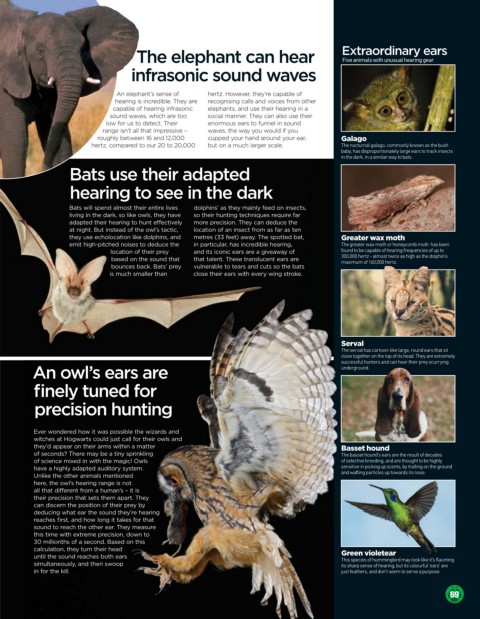
Extraordinary ears
The elephant can hear Conservation breaks
Five animals with unusual hearing gear
infrasonic sound waves
An elephant’s sense of hertz. However, they’re capable of
hearing is incredible. They are recognising calls and voices from other
capable of hearing infrasonic elephants, and use their hearing in a
sound waves, which are too social manner. They can also use their
low for us to detect. Their enormous ears to funnel in sound
range isn’t all that impressive – waves, the way you would if you
roughly between 16 and 12,000 cupped your hand around your ear, G a la go
Snow leopards in Kyrgyzstan
hertz, compared to our 20 to 20,000 but on a much larger scale. T Learn how snow leopard populations are monitored
g
o
e b
a
s
c
t
o
h
e n
h
u
l g
a
l
a
r
u
n
l
y k
n
m
o
o
m
, c
s t
n a
n
o
h
w
s
r
g
i
e e
y
r
s t
b
, h
a
s d
o t
a
k i
t
t
a
e
o
i
n
a
c
a
p
o
p
r
y l
l
r
o
r
a
b through tracking their trails, kills, and scat while nsects
e d
m
i
i
n a s
r w
.
t
l
i
n t
staying in an expedition-style base camp.
a
s
h
a
k
, i
a
y t
o b
a
r
Bats use their adapted
hearing to see in the dark
Bats will spend almost their entire lives dolphins’ as they mainly feed on insects,
living in the dark, so like owls, they have so their hunting techniques require far
adapted their hearing to hunt effectively more precision. They can deduce the
at night. But instead of the owl’s tactic, location of an insect from as far as ten
t
r w
a
G
a
e
e
r
they use echolocation like dolphins, and metres (33 feet) away. The spotted bat, British wildlifex moth
emit high-pitched noises to deduce the in particular, has incredible hearing, Get your hands dirty and get involved in a National Trust
m
y
b m
o
x m
r
t
t
a
e
e
e
n
r h
n
a
r w
h
h h
o
o
e
c
h o
e g
t
o
e
T
a
s b
a
r
e
o
f u
r
e
e c
b
q
i
p t
s o
e o
l
e
a
p
n
e
a
f
u
f h
i
o b
d t
u
g f
c
n
o
n
location of their prey and its iconic ears are a giveaway of working holiday. Take part in practical conservation
h
i
r
g
o
s
0 h
0
3
l
h a
m
z - a
h
l
’
0
p
i
,
s t
e a
t
e d
c
n
e
0
w
t t
s h
o
i
s
0
based on the sound that that talent. These translucent ears are from planting trees to butterfly surveys and learn about
m o
a
0
u
f 1
,
the problems British wildlife faces.
r
.
0
6
i
m
m
0
x
t
0 h
z
e
bounces back. Bats’ prey vulnerable to tears and cuts so the bats
is much smaller than close their ears with every wing stroke.
l
Whales in Tenerife
r
S
va
e
n
o
g
i
i
a
d e
e s
l
e
r
n
h
-
, r
r
r
k
s t
e l
t
o
t
t s
a
r
h
a
s c
a
o
T
l h
a
Keeping tabs on whale populations is an important part
e
u
v
a
e
e
.
g
t
a
l
o
l
h
h
e
e
m
c
e
o
o
e
e
o
T
r
h
t
s
e
t
p
h
r
t
i
s
f
e
e
y
n
t
d
r
o
x
t
y
a
of checking marine health. Volunteer on a whale survey
r
u
g
s
y s
e
n h
r
n
r
r t
i
a
t
f
i
y
e
c
h
d c
s
e
c
c
n
e
l h
s a
s
u
boat and really make a difference while seeing whales
a
r
u
r p
e
n
u
An owl’s ears are in the wild.nd.
er
u
gr
o
u
d
n
finely tuned for
precision hunting
Ever wondered how it was possible the wizards and
witches at Hogwarts could just call for their owls and
they’d appear on their arms within a matter Sand foxes in Dubai
B
s
t
s
hou
d
e
a
n
of seconds? There may be a tiny sprinkling These creatures are not yet endangered but as Dubai is
e r
h
r
e
e t
e
t h
T
s
o
e
u
s
t o
a
h
e b
f d
l
s
u
’
d
r
a
a
d
s e
s a
n
c
e
s
of science mixed in with the magic! Owls o associated with rapid developments there are projects
t t
o b
e h
h
g
o
u
h
i
g
, a
g
v
d a
t
i
n
d
r
e
h
e
n
e b
i
l
y
e
r
e t
l
f s
c
e
r
s
g o
e
k
c
n
n
i
i
i
t
v
l
o
i
n p
u
e i
n
i
n
y t
d
g u
t
p s
h
e g
e
c
, b
r
a
n t
n
s
i
have a highly adapted auditory system. s underway to safeguard population for the future, which
a
a
n
d w
t
l
e
a
i
c
g p
i
r
s u
n
Unlike the other animals mentioned you can get involved in. p towards its nose.
here, the owl’s hearing range is not
all that different from a human’s – it is
their precision that sets them apart. They
can discern the position of their prey by
deducing what ear the sound they’re hearing
reaches first, and how long it takes for that
sound to reach the other ear. They measure
this time with extreme precision, down to
30 millionths of a second. Based on this
calculation, they turn their head Lynx in Slovakia
r
a
e
v
r
e
e
n
t
i
ole
G
until the sound reaches both ears Trek up high into the Carpathian Mountains in search ng
g
i
c
u
b
e
u
t
i
s o
m
a
s fl
’
f h
e
n
m
y l
i
i
s s
a
o
t
k
i
h
o
i
d m
r
p
k l
e i
T
n
simultaneously, and then swoop of lynxes, wolves, and bears. Join local scientists and
s
s
i
e o
t
r
h
a
r
p s
’ a
n
s s
e
e
n
g
u
o
f
i
e
l ‘
u
t i
, b
s c
t
r
l
f h
o
e
r
a
r
u
a
in for the kill. learn how to radio collar and set camera traps.se.
t f
o s
u
v
u
j
r
s
e
e a p
’
n
r
o
t s
d d
n
o
s
, a
a
e
e
m t
r
e
e
h
p
t
69

