


Page 71 - World of Animals - Issue #28 Magazine
P. 71
Bizarre!


               The strange creature that                                                                  STAR-NOSED MOLE
                                                                                                          Condylura cristata
                                                                                                          Class Mammalia
               looks like a cross between

               a shrew and an octopus                                                                     Territory Southeastern Canada
                                                                                                          and northeastern United States
                                                                                                          Diet Terrestrial and aquatic
                                                                                                          invertebrates
              The star-nosed mole has tentacles on its face, lives life                                   Lifespan 3-4 years
                                                                                                          Adult weight 35-75g (1-3oz)
              underground, and has an unusual talent for speed eating                                     Conservation status

                                                                                                          LEAST CONCERN

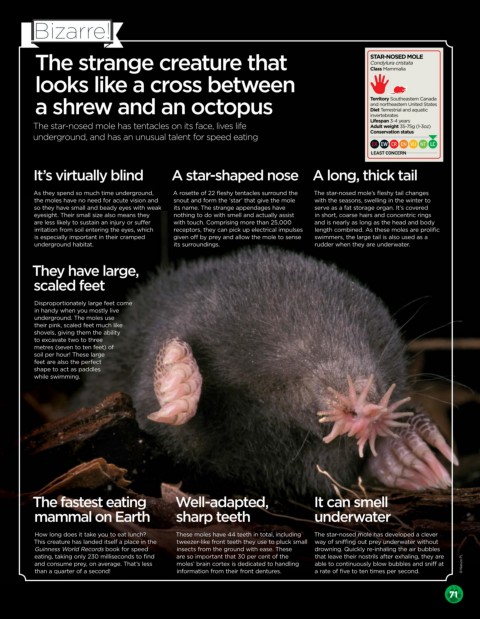
              It’s virtually blind                  A star-shaped nose A long, thick tail


              As they spend so much time underground,   A rosette of 22 fleshy tentacles surround the   The star-nosed mole’s fleshy tail changes

              the moles have no need for acute vision and   snout and form the ‘star’ that give the mole   with the seasons, swelling in the winter to
              so they have small and beady eyes with weak   its name. The strange appendages have   serve as a fat storage organ. It’s covered
              eyesight. Their small size also means they   nothing to do with smell and actually assist   in short, coarse hairs and concentric rings
              are less likely to sustain an injury or suffer   with touch. Comprising more than 25,000   and is nearly as long as the head and body

              irritation from soil entering the eyes, which   receptors, they can pick up electrical impulses   length combined. As these moles are prolific
              is especially important in their cramped   given off by prey and allow the mole to sense   swimmers, the large tail is also used as a
              underground habitat.                  its surroundings.                      rudder when they are underwater.
              They have large,
              scaled feet


              Disproportionately large feet come
              in handy when you mostly live
              underground. The moles use
              their pink, scaled feet much like
              shovels, giving them the ability
              to excavate two to three
              metres (seven to ten feet) of
              soil per hour! These large
              feet are also the perfect
              shape to act as paddles
              while swimming.


              The fastest eating                     Well-adapted,                         It can smell

              mammal on Earth                        sharp teeth                           underwater


               How long does it take you to eat lunch?   These moles have 44 teeth in total, including   The star-nosed mole has developed a clever
              This creature has landed itself a place in the   tweezer-like front teeth they use to pluck small  way of sniffing out prey underwater without

              Guinness World Records book for speed   insects from the ground with ease. These   drowning. Quickly re-inhaling the air bubbles

              eating, taking only 230 milliseconds to find   are so important that 30 per cent of the   that leave their nostrils after exhaling, they are
              and consume prey, on average. That’s less   moles’ brain cortex is dedicated to handling   able to continuously blow bubbles and sniff at   © Nature PL
               than a quarter of a second!           information from their front dentures.   a rate of five to ten times per second.

                                                                                                                               71

