


Page 75 - World of Animals - Issue #28 Magazine
P. 75
Living light


              Who glows there?


              From recycling the Sun’s rays to complex chemical reactions, there are various types of glow


                                                             Bioluminescence

                                                             Creating light from darkness

                                                             The term bioluminescence is used to   which is why deep-sea creatures like

                                                             describe light that is produced by a   anglerfish can use it to lure their prey.
                                                             chemical reaction inside an organism.   There are at least four different types
                                                             The vital substance in this reaction is   of luciferin in animals, each with
                                                             luciferin, which can react with oxygen   a corresponding luciferase. Some
                                                             to produce light. The process is aided   bioluminescent species rely on a
                                                             by the enzyme luciferase, but doesn’t   supply of these molecules within their
                                                             need an external source of light,   diet, as they are unable to create them.

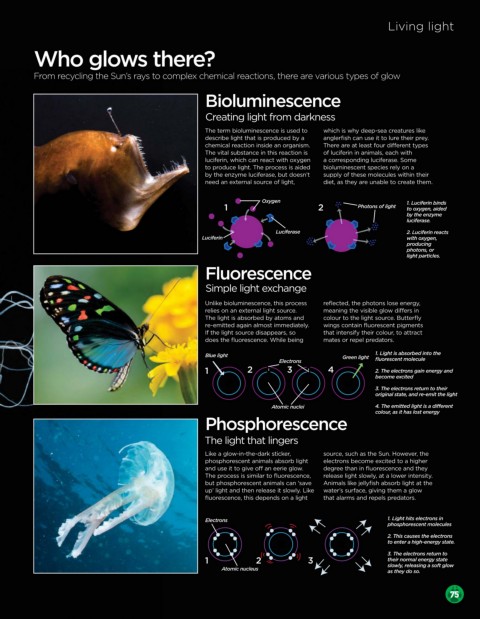
                                                                            Oxygen                                  1. Luciferin binds
                                                                  1                         2         Photons of light  to oxygen, aided
                                                                                                                    by the enzyme
                                                                                                                    luciferase.
                                                                                Luciferase                          2. Luciferin reacts
                                                            Luciferin                                               with oxygen,
                                                                                                                    producing
                                                                                                                    photons, or
                                                                                                                    light particles.
                                                             Fluorescence

                                                             Simple light exchange

                                                             Unlike bioluminescence, this process   reflected, the photons lose energy,

                                                             relies on an external light source.   meaning the visible glow differs in

                                                             The light is absorbed by atoms and   colour to the light source. Butterfly
                                                             re-emitted again almost immediately.   wings contain fluorescent pigments

                                                             If the light source disappears, so   that intensify their colour, to attract

                                                             does the fluorescence. While being   mates or repel predators.
                                                             Blue light                           Green light  1. Light is absorbed into the

                                                                                 Electrons                 fluorescent molecule
                                                             1          2          3          4            2. The electrons gain energy and
                                                                                                           become excited
                                                                                                           3. The electrons return to their
                                                                                                           original state, and re-emit the light
                                                                               Atomic nuclei               4. The emitted light is a different
                                                                                                           colour, as it has lost energy
                                                             Phosphorescence

                                                             The light that lingers

                                                             Like a glow-in-the-dark sticker,   source, such as the Sun. However, the
                                                             phosphorescent animals absorb light   electrons become excited to a higher

                                                             and use it to give off an eerie glow.   degree than in fluorescence and they

                                                             The process is similar to fluorescence,   release light slowly, at a lower intensity.

                                                             but phosphorescent animals can ‘save   Animals like jellyfish absorb light at the
                                                             up’ light and then release it slowly. Like   water’s surface, giving them a glow

                                                             fluorescence, this depends on a light   that alarms and repels predators.
                                                             Electrons                                         1. Light hits electrons in
                                                                                                               phosphorescent molecules
                                                                                                               2. This causes the electrons
                                                                                                               to enter a high-energy state.
                                                                                                               3. The electrons return to
                                                             1             2             3                     their normal energy state
                                                                 Atomic nucleus                                slowly, releasing a soft glow
                                                                                                               as they do so.
                                                                                                                               75

