


Page 108 - World of Animals - Book of Sharks & Ocean Predators
P. 108
Sharks & Ocean Predators
                               WorldMags.net


       Meet the family


       Rays                              These sly hunters are perfectly


                                         adapted to their habitat


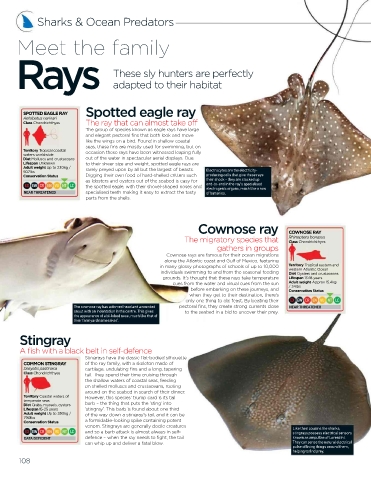
                               Spotted eagle ray
         SPOTTED EAGLE RAY
         Aetobatus narinari
         Class Chondrichthyes  The ray that can almost take off
                               The group of species known as eagle rays have large
                               and elegant pectoral fins that both look and move

                               like the wings on a bird. Found in shallow coastal
                               seas, these fins are mostly used for swimming, but on

         Territory Tropical coastal   occasion these rays have been witnessed leaping fully
         waters worldwide
         Diet Molluscs and crustaceans  out of the water in spectacular aerial displays. Due
         Lifespan Unknown      to their sheer size and weight, spotted eagle rays are
         Adult weight Up to 230kg /   rarely preyed upon by all but the largest of beasts.
         507lbs                                                           Electrocytes are the electricity-
         Conservation Status   Digging their own food of hard-shelled critters such   producing cells that give these rays
                               as lobsters and oysters out of the seabed is easy for   their shock – they are stacked up
                                                                          end-to-end in the ray’s specialised
                               the spotted eagle, with their shovel-shaped noses and
                                                                          electrogenic organs, much like a row
         NEAR THREATENED       specialised teeth making it easy to extract the tasty   of batteries.
                               parts from the shells.

                                                                       Cownose ray                    COWNOSE RAY

                                                                  The migratory species that          Rhinoptera bonasus
                                                                                                      Class Chondrichthyes
                                                                             gathers in groups
                                                            Cownose rays are famous for their ocean migrations
                                                           along the Atlantic coast and Gulf of Mexico, featuring
                                                         in many glossy photographs of schools of up to 10,000   Territory Tropical eastern and
                                                                                                      western Atlantic Ocean
                                                         individuals swimming to and from the seasonal feeding   Diet Oysters and crustaceans
                                                          grounds. It’s thought that these rays take temperature   Lifespan 13-18 years
                                                              cues from the water and visual cues from the sun   Adult weight Approx 15.4kg
                                                                                                      / 34lbs
                                                                    before embarking on these journeys, and   Conservation Status
                                                                    when they get to their destination, there’s
                                                                  only one thing to do: feast. By beating their

                           The cownose ray has a domed head and a rounded   pectoral fins, they create strong currents close   NEAR THREATENED
                           snout with an indentation in the centre. This gives   to the seabed in a bid to uncover their prey.
                           the appearance of a bi-lobed nose, much like that of
                           their farmyard namesakes’.

        Stingray
        A fish with a black belt in self-defence

                               Stingrays have the classic fl at-bodied silhouette
         COMMON STINGRAY       of the ray family, with a skeleton made of
         Dasyatis pastinaca    cartilage, undulating fins and a long, tapering

         Class Chondrichthyes
                               tail. They spend their time cruising through
                               the shallow waters of coastal seas, feeding
                               on shelled molluscs and crustaceans, rooting
                               around on the seabed in search of their dinner.
         Territory Coastal waters of   However, this species’ trump card is its tail
         temperate seas
         Diet Crabs, mussels, oysters  barb – the thing that puts the ‘sting’ into
         Lifespan 15-25 years  ‘stingray’. This barb is found about one third
         Adult weight Up to 350kg /   of the way down a stingray’s tail, and it can be
         790lbs
         Conservation Status   a formidable-looking spike containing potent
                               venom. Stingrays are generally docile creatures
                                                                                                        Like their cousins the sharks,
                               and so a barb attack is almost always in self-                           stingrays possess electrical sensors

         DATA DEFICIENT        defence – when the ray needs to fight, the tail                           known as ampullae of Lorenzini.
                               can whip up and deliver a fatal blow.                                    They can sense the natural electrical
                                                                                                        pulse of living things around them,
                                                                                                        helping to find prey.

        1  0  8
                                                      WorldMags.net
                                                      WorldMags.net

