


Page 121 - World of Animals - Book of Sharks & Ocean Predators
P. 121
Atlantic blue marlin
                               WorldMags.net


                                                                              Low odds
                                                                              Only around
                                                                             one per-cent of
                                                                          marlin eggs make it to
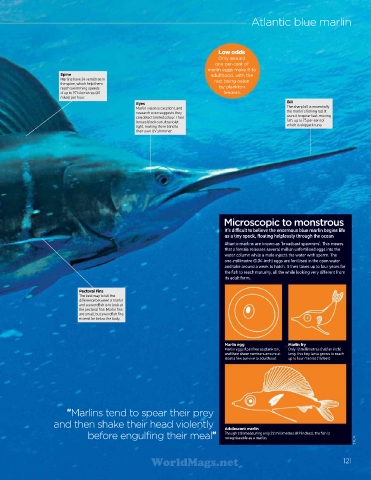
                      Spine                                                adulthood, with the
                      Marlins have 24 vertebrae in                          rest being eaten
                      the spine, which help them
                      reach swimming speeds                                   by plankton
                      of up to 97 kilometres (60                                feeders.
                      miles) per hour.
                                                                                                      Bill
                                                 Eyes
                                                 Marlin vision is excellent, and                      The sharp bill is essentially

                                                 research even suggests they                          the marlin’s fishing rod. It
                                                 can detect limited colour. Their                     uses it to spear fast-moving

                                                 lenses block out ultraviolet                         fish, up to 75 per-cent of
                                                 light, making them blind to                          which is skipjack tuna
                                                 their own UV shimmer.


                                                                                Microscopic to monstrous
                                                                                It’s difficult to believe the enormous blue marlin begins life


                                                                                as a tiny speck, floating helplessly through the ocean
                                                                                Altantic marlins are known as ‘broadcast spawners’. This means
                                                                                that a female releases several million unfertilised eggs into the
                                                                                water column while a male injects the water with sperm. The
                                                                                one-millimetre (0.04-inch) eggs are fertilised in the open water
                                                                                and take around a week to hatch. It then takes up to four years for
                                                                                the fish to reach maturity, all the while looking very diff erent from

                                                                                its adult form.
                             Pectoral Fins
                             The best way to tell the
                             difference between a marlin

                             and a swordfish is to look at

                             the pectoral fins. Marlin fins


                             are small, but swordfish fins
                             extend far below the body.
                                                                                Marlin egg            Marlin fry
                                                                                Marlin eggs float free as plankton,   Only 12 millimetres (half an inch)

                                                                                and their sheer numbers ensure at   long, this tiny larva grows to reach
                                                                                least a few survive to adulthood.  up to four metres (14 feet).


                         “Marlins tend to spear their prey
                    and then shake their head violently
                                                                                Adolescent marlin
                                before engulfing their meal”                     Though still measuring only 22 millimetres (0.9 inches), the fish is


                                                                                                                              © FLPA
                                                                                recogniseable as a marlin.
                                                                                                                          121
                                                      WorldMags.net
                                                      WorldMags.net

