


Page 124 - World of Animals - Book of Sharks & Ocean Predators
P. 124
Sharks & Ocean Predators
                               WorldMags.net

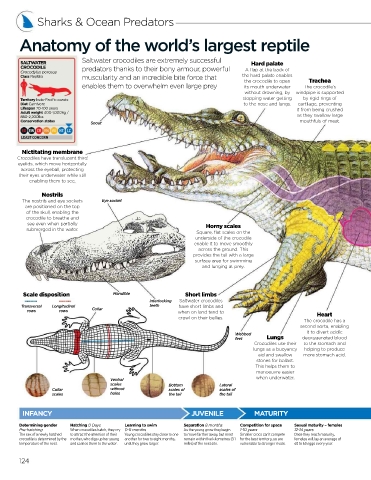
        Anatomy of the world’s largest reptile


                              Saltwater crocodiles are extremely successful
        SALTWATER                                                                        Hard palate
        CROCODILE             predators thanks to their bony armour, powerful          A flap at the back of

        Crocodylus porosus
        Class Reptilia        muscularity and an incredible bite force that           the hard palate enables
                                                                                       the crocodile to open   Trachea
                              enables them to overwhelm even large prey                its mouth underwater   The crocodile’s
                                                                                       without drowning, by  windpipe is supported
        Territory Indo-Pacifi c coasts                                                 stopping water getting   by rigid rings of
        Diet Carnivore                                                                 to the nose and lungs.  cartilage, preventing
        Lifespan 70-100 years                                                                            it from being crushed
        Adult weight 400-1,000kg /
        880-2,200lbs                                                                                     as they swallow large
        Conservation status                                                                               mouthfuls of meat.
                                 Snout
        LEAST CONCERN

         Nictitating membrane
       Crocodiles have translucent third
       eyelids, which move horizontally
        across the eyeball, protecting
        their eyes underwater while still
           enabling them to see.

                Nostrils
         The nostrils and eye sockets   Eye socket
          are positioned on the top
          of the skull, enabling the
          crocodile to breathe and
           see even when partially
          submerged in the water.                                        Horny scales
                                                                      Square, flat scales on the

                                                                      underside of the crocodile
                                                                     enable it to move smoothly
                                                                       across the ground. This
                                                                     provides the tail with a large
                                                                      surface area for swimming
                                                                        and lunging at prey.


         Scale disposition               Mandible                 Short limbs
                                                      Interlocking   Saltwater crocodiles
        Transversal   Longitudinal                    teeth     have short limbs and
           rows       rows       Collar                         when on land tend to
                                                                crawl on their bellies.                         Heart
                                                                                                            The crocodile has a
                                                                                                          second aorta, enabling
                                                                                                             it to divert acidic
                                                                                    Webbed
                                                                                    feet       Lungs       deoxygenated blood
                                                                                          Crocodiles use their   to the stomach and
                                                                                          lungs as a buoyancy   helping to produce
                                                                                            aid and swallow   more stomach acid.
                                                                                           stones for ballast.
                                                                                           This helps them to
                                                                                           manoeuvre easier
                                                                                           when underwater.
                                        Ventral
                                        scales              Bottom            Lateral
                   Collar               without             scales of         scales of
                   scales               holes               the tail          the tail


         INFANCY                                                    JUVENILE              MATURITY

        Determining gender   Hatching 0 Days  Learning to swim    Separation 8 months  Competition for space   Sexual maturity – females
        Pre-hatching      When crocodiles hatch, they cry  0-8 months  As the young grow they begin   1-10 years   12-14 years
        The sex of a newly hatched   to attract the attention of their   Young crocodiles stay close to one   to move farther away, but most   Smaller crocs can’t compete   Once they reach maturity,

        crocodile is determined by the   mother, who digs up her young   another for two to eight months,   remain within five kilometres (3.1  for the best territory, so are   females will lay an average of
        temperature of the nest.   and carries them to the water.  until they grow larger.  miles) of the nest site.  vulnerable to stronger rivals.   40 to 60 eggs every year.
        124
                                                      WorldMags.net
                                                      WorldMags.net

