


Page 137 - World of Animals - Book of Sharks & Ocean Predators
P. 137
Narwhals
                               WorldMags.net

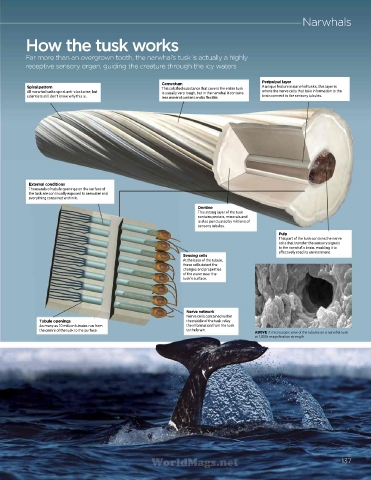
          How the tusk works


          Far more than an overgrown tooth, the narwhal’s tusk is actually a highly
          receptive sensory organ, guiding the creature through the icy waters


                                                                                             Peripulpal layer
                                                          Cementum
           Spiral pattern                                 This calcified substance that covers the entire tusk   A unique feature in narwhal tusks, this layer is

           All narwhal tusks spiral anti-clockwise, but   is usually very tough, but in the narwhal it contains   where the nerve cells that take information to the
           scientists still don’t know why this is.       less mineral content and is flexible.   brain connect to the sensory tubules.


           External conditions
           Thousands of tubule openings on the surface of
           the tusk are continually exposed to seawater and
           everything contained within it.
                                                                       Dentine
                                                                       This strong layer of the tusk
                                                                       contains protein, minerals and
                                                                       is also punctuated by millions of
                                                                       sensory tubules.
                                                                                                   Pulp
                                                                                                   This part of the tusk contains the nerve
                                                                                                   cells that transfer the sensory signals
                                                                                                   to the narwhal’s brain, enabling it to
                                                                                                   effectively read its environment.

                                                                 Sensing cells
                                                                 At the base of the tubule,
                                                                 these cells detect the
                                                                 changes and properties
                                                                 of the water near the
                                                                 tusk’s surface.


                                                                   Nerve network
                                                                   Nerve cells contained within
               Tubule openings                                     the middle of the tusk relay
               As many as 10 million tubules run from              the information from the tusk
               the centre of the tusk to the surface.              to the brain.
                                                                                           ABOVE A microscopic view of the tubules on a narwhal tusk
                                                                                           at 1,000x magnifi cation strength


                                                                                                                         137
                                                      WorldMags.net
                                                      WorldMags.net

