


Page 138 - World of Animals - Book of Sharks & Ocean Predators
P. 138
Sharks & Ocean Predators
                               WorldMags.net


        was a critical piece because no one has really ever looked
        at this aspect, as a sensory organ.” When they examined
        the tusk up close, Dr Nweeia and his team found tiny
        tubes, known as tubules that run from the tusk’s nerve-
        rich core right through to the outer shell. These tubules are
        exposed to the seawater and send signals down the tubes,
        concerning the composition of the seawater, and what is
        in it, to special cells at the bottom. These cells process the
        information and pass it to the nerves, which then take this
        data up the tusk to the narwhal’s brain.
          In order to test this theory, the team travelled to the
        Arctic Circle to gather data from wild narwhal subjects.
        Dr Nweeia takes us through his technique for testing the
        sensitivity of the tusk: “After the narwhal was brought to
        shore, we would cover a half-metre section of the tusk
        with the tusk jacket and attach the heart- and brain-
        monitoring equipment to the whale. This was to observe
        brain and heart rate activity while we stimulated the tusk
        with solutions. Inside the tusk jacket, we would inject
        solutions of alternating high salt and fresh water, while
        monitoring the whale’s reaction.” This typically took
        around 20 minutes, with minimal stress on the whale. “On

        any field expedition, we would catch and release about


        five to eight whales to enable sufficient samples to be
        analysed,” Dr Nweeia continues.

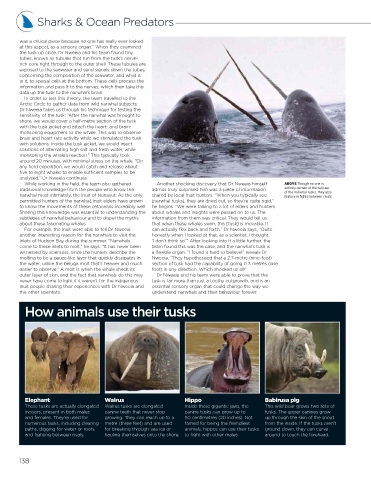
          While working in the field, the team also gathered   Another shocking discovery that Dr Nweeia himself   ABOVE Though no one is
        traditional knowledge from the people who know the   admits truly surprised him was a piece of information   entirely certain of the full use
                                                                                                     of the narwhal tusks, they also
        narwhal most intimately, the Inuit of Nunavut. As the only   shared by local Inuit hunters. “When you typically see   feature in fi ghts between rivals
        permitted hunters of the narwhal, Inuit elders have grown   [narwhal tusks], they are dried out, so they’re quite rigid,”
        to know the movements of these cetaceans incredibly well.  he begins. “We were talking to a lot of elders and hunters
        Sharing this knowledge was essential to understanding the   about whales and insights were passed on to us. The
        subtleties of narwhal behaviour and to dispel the myths   information from them was critical. They would tell us
        about these fascinating whales.               that when these whales swim, this [tusk] is movable. It
          For example, the Inuit were able to tell Dr Nweeia   can actually flex back and forth.” Dr Nweeia says, “Quite

        another interesting reason for the narwhals to visit the   honestly when I looked at that, as a scientist, I thought
        inlets of Hudson Bay during the summer. “Narwhals   ‘I don’t think so.’” After looking into it a little further, the
        come to these inlets to molt,” he says. “It has never been   team found this was the case, and the narwhal’s tusk is

        witnessed by scientists, since the hunters describe the   a flexible organ. “I found it hard to believe!” reveals Dr
        molting to be a gauze-like layer that quickly dissipates in   Nweeia. “They hypothesised that a 2.7-metre (nine-foot)
        the water, unlike the beluga molt that’s heavier and much   section of tusk had the capability of going 0.3 metres (one
        easier to observe.” A molt is when the whale sheds its   foot) in any direction. Which shocked us all!”
        outer layer of skin, and the fact that narwhals do this may   Dr Nweeia and his team were able to prove that the
        never have come to light if it weren’t for the indigenous   tusk is far more than just a toothy outgrowth, and is an
        Inuit people sharing their experiences with Dr Nweeia and   essential sensory organ that could change the way we
        the other scientists.                         understand narwhals and their behaviour forever.
          How animals use their tusks


          Elephant                    Walrus                      Hippo                       Babirusa pig
          These tusks are actually elongated  Walrus tusks are elongated   Inside these gigantic jaws, the   This wild boar grows two sets of
          incisors, present in both males   canine teeth that never stop   canine tusks can grow up to   tusks. The upper canines grow
          and females. They’re used for   growing. They can reach up to a   50 centimetres (20 inches). Not   up through the skin of the snout
          numerous tasks, including clearing   metre (three feet) and are used   famed for being the friendliest   from the inside. If the tusks aren’t
          paths, digging for water or roots   for breaking through sea ice or   animals, hippos can use their tusks  ground down, they can curve


          and fighting between rivals.  hauling themselves onto the shore.  to fight with other males.   around to touch the forehead.

        138
                                                      WorldMags.net
                                                      WorldMags.net

