


Page 28 - World of Animals - Book of Sharks & Ocean Predators
P. 28
Sharks & Ocean Predators
                               WorldMags.net


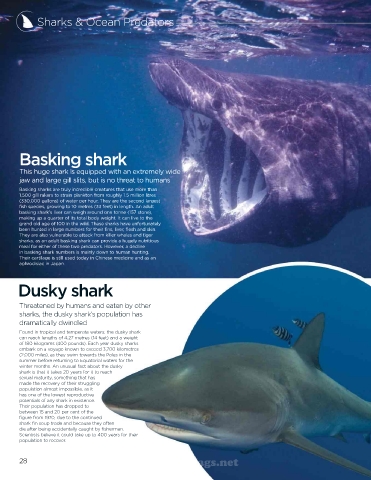
        Basking shark

        This huge shark is equipped with an extremely wide
        jaw and large gill slits, but is no threat to humans
        Basking sharks are truly incredible creatures that use more than
        1,500 gill rakers to strain plankton from roughly 1.5 million litres
        (330,000 gallons) of water per hour. They are the second largest

        fish species, growing to 10 metres (33 feet) in length. An adult
        basking shark’s liver can weigh around one tonne (157 stone),
        making up a quarter of its total body weight. It can live to the
        grand old age of 100 in the wild. These sharks have unfortunately

        been hunted in large numbers for their fins, liver, flesh and skin.

        They are also vulnerable to attack from killer whales and tiger
        sharks, as an adult basking shark can provide a hugely nutritious
        meal for either of these two predators. However, a decline
        in basking shark numbers is mainly down to human hunting.
        Their cartilage is still used today in Chinese medicine and as an
        aphrodisiac in Japan.


       Dusky shark


        Threatened by humans and eaten by other
        sharks, the dusky shark’s population has
        dramatically dwindled
        Found in tropical and temperate waters, the dusky shark
        can reach lengths of 4.27 metres (14 feet) and a weight
        of 180 kilograms (400 pounds). Each year dusky sharks
        embark on a voyage known to exceed 3,700 kilometres
        (2,000 miles), as they swim towards the Poles in the
        summer before returning to Equatorial waters for the
        winter months. An unusual fact about the dusky
        shark is that it takes 20 years for it to reach
        sexual maturity, something that has
        made the recovery of their struggling
        population almost impossible, as it
        has one of the lowest reproductive
        potentials of any shark in existence.
        Their population has dropped to
        between 15 and 20 per cent of the

        figure from 1970, due to the continued

        shark fin soup trade and because they often
        die after being accidentally caught by fi sherman.
        Scientists believe it could take up to 400 years for their
        population to recover.

        28
                                                      WorldMags.net
                                                      WorldMags.net

