


Page 58 - World of Animals - Book of Sharks & Ocean Predators
P. 58
Sharks & Ocean Predators
                               WorldMags.net

        Using taste


        A hammerhead’s sense of taste isn’t as well-developed
        because their other senses do most of the work. Once the
        shark has seen or smelled the prey the shark has to give it
        a good chew to discover exactly what it tastes like. Sharks
        do have taste buds, but they can only detect fl avour once
        the item is inside the mouth and items that are foul-tasting
        will be spat out. This has been demonstrated by sea otter

        carcasses that are found floating out at sea that exhibit
        bite marks. Sharks don’t eat the otters, they simply have
        a taste and discard them. This also explains why many
        victims of shark attacks survive, as sharks bite before
        realising that a human is not suitable meal.


       “Sharks do have taste buds, but

        they can only detect fl avour once
        the item is inside the mouth, and

        items that are foul-tasting will be
        spat out”


                                                                                                              Cupula


         Sensing water pressure

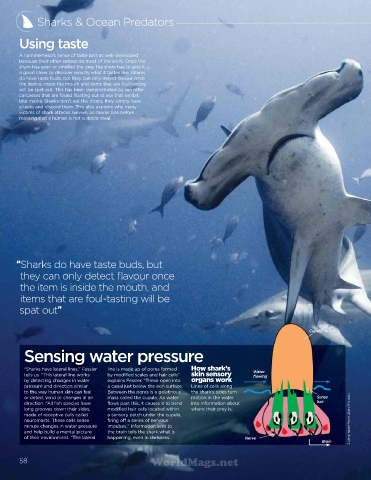
         “Sharks have lateral lines,” Fessler   line is made up of pores formed   How shark’s   Water

         tells us. “This lateral line works   by modified scales and hair cells”   skin sensory   fl owing
         by detecting changes in water   explains Fessler. “These open into   organs work
         pressure and direction similar   a canal just below the skin surface.   Lines of cells along
         to the way human skin can feel   Between the pores is a gelatinous   the shark’s sides turn
         or detect wind or changes in air   mass called the cupula. As water   motion in the water              Sense


         direction. “All fish species have   flows past this, it causes it to bend   into information about       hair

         long grooves down their sides,   modified hair cells located within   where their prey is.
         made of receptive cells called   a sensory patch under the cupula,

         neuromasts. These cells sense   firing off a series of nervous                                                      © Alamy, Nature Picture Library, Thinkstock
         minute changes in water pressure   impulses.” Information sent to
         and help build a mental picture   the brain tells the shark what is
         of their environment. “The lateral   happening, even in darkness.             Nerve
                                                                                                                  Brain
        58
                                                      WorldMags.net
                                                      WorldMags.net

