


Page 60 - World of Animals - Book of Sharks & Ocean Predators
P. 60
Sharks & Ocean Predators
                               WorldMags.net

        King of the sharks


        Whale shark


        The largest living fish is the whale shark,

        which reaches an average length of just
        under 10 metres (33 feet). The largest
        confirmed individual measured a huge

        12.65 metres (41.5 feet) and weighed
        21,320 kilograms (47,000 pounds), with

        unconfirmed reports of even larger fi sh.
          The whale shark has thousands of teeth,
        each of which is two millimetres (0.08
        inches) in length, arranged in around 300
        rows pointing backward into its mouth.
        But they are not used for hunting. The

        whale shark is actually a filter feeder. As
        it swims along, it opens its wide, square
        mouth, taking in water and fi ltering it
        through a series of cartilaginous spines
        that cover its gills. They act as a sieve,
        extracting zooplankton like krill, jellyfi sh
        and crustaceans.
          It might seem unusual that the largest
        fish in the sea would eat some of the

        smallest life forms, but the second largest
        fish, the basking shark, is also a fi lter

        feeder, as are many large whales. Schools
        of fish are often hard to find but eating the


        abundant microscopic ocean life enables
        whale sharks to survive on little food.
          Like many other large species, the whale
        shark takes a long time to mature, so it
        consequently has a long life span. They do
        not reach adulthood until the age of 30,
        and it is thought that they might live to be
        100 years old, although this has not yet
        been proven.
         WHALE SHARK
         Rhincodon typus
         Class Chondrichthyes


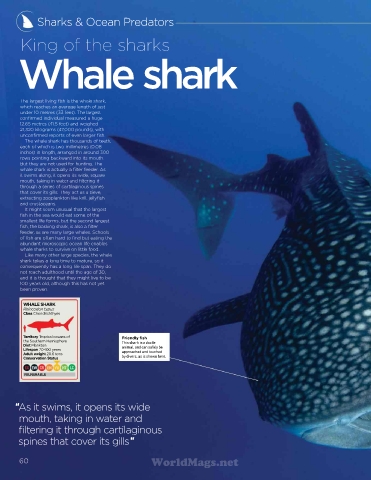
         Territory Tropical oceans of       Friendly fi sh
         the Southern Hemisphere            This shark is a docile
         Diet Plankton                      animal, and can safely be
         Lifespan 70-100 years              approached and touched
         Adult weight 20.6 tons             by divers, as is shown here.
         Conservation Status

         VULNERABLE


      “As it swims, it opens its wide

        mouth, taking in water and
        filtering it through cartilaginous

        spines that cover its gills ”


        60
                                                      WorldMags.net
                                                      WorldMags.net

