


Page 68 - World of Animals - Book of Sharks & Ocean Predators
P. 68
Sharks & Ocean Predators
                               WorldMags.net


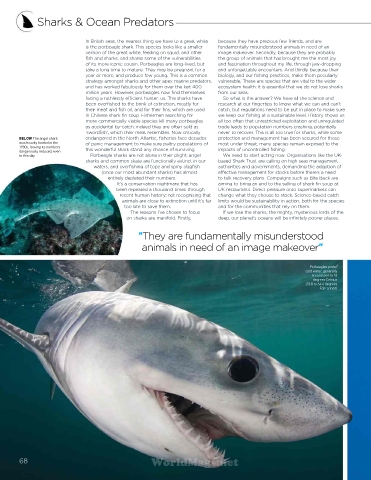
                               In British seas, the nearest thing we have to a great white
                               is the porbeagle shark. This species looks like a smaller   because they have precious few friends, and are
                                                                              fundamentally misunderstood animals in need of an
                               version of the great white, feeding on squid, and other   image makeover. Secondly, because they are probably
                               fish and sharks, and shares some of the vulnerabilities   the group of animals that has brought me the most joy

                               of its more iconic cousin. Porbeagles are long-lived, but   and fascination throughout my life, through jaw-dropping
                               take a long time to mature. They may be pregnant for a   and unforgettable encounters. And thirdly because their
                               year or more, and produce few young. This is a common   biology, and our fishing practices, make them peculiarly

                               strategy amongst sharks and other apex marine predators,   vulnerable. These are species that are vital to the wider
                               and has worked fabulously for them over the last 400   ecosystem health: it is essential that we do not lose sharks
                               million years. However, porbeagles now fi nd themselves   from our seas.

                               facing a ruthlessly efficient hunter: us. The sharks have   So what is the answer? We have all the science and


                               been overfished to the brink of extinction, mostly for   research at our fingertips to know what we can and can’t


                               their meat and fish oil, and for their fins, which are used   catch, but regulations need to be put in place to make sure

                               in Chinese shark fin soup. Fishermen searching for   we keep our fishing at a sustainable level. History shows us

                               more commercially viable species kill many porbeagles   all too often that unrestricted exploitation and unregulated
                               as accidental by-catch; indeed they are often sold as   trade leads to population numbers crashing, potentially

                               ‘swordfish’, which their meat resembles. Now critically   never to recover. This is all too true for sharks; while some

        BELOW The angel shark   endangered in the North Atlantic, fisheries face decades   protection and management has been secured for those
        was heavily hunted in the   of panic management to make sure paltry populations of   most under threat, many species remain exposed to the
        1980s, leaving its numbers
        dangerously reduced, even   this wonderful shark stand any chance of surviving.   impacts of uncontrolled fi shing.
        to this day              Porbeagle sharks are not alone in their plight; angel   We need to start acting now. Organisations like the UK-
                               sharks and common skate are functionally extinct in our   based Shark Trust are calling on high seas management
                                  waters, and overfishing of tope and spiny dogfi sh   authorities and governments, demanding the adoption of

                                     (once our most abundant sharks) has almost   effective management for stocks before there’s a need
                                       entirely depleted their numbers.       to talk recovery plans. Campaigns such as Bite Back are
                                          It’s a conservation nightmare that has   aiming to bring an end to the selling of shark fin soup at

                                          been repeated a thousand times through   UK restaurants. Direct pressure onto supermarkets can
                                           recent human history: not recognising that   change what they choose to stock. Science-based catch
                                            animals are close to extinction until it’s far   limits would be sustainability in action, both for the species
                                             too late to save them.           and for the communities that rely on them.
                                               The reasons I’ve chosen to focus   If we lose the sharks, the mighty, mysterious lords of the

                                             on sharks are manifold. Firstly,   deep, our planet’s oceans will be infinitely poorer places.
                                                  “They are fundamentally misunderstood
                                                   animals in need of an image makeover”
                                                                                                              Porbeagles prefer
                                                                                                            cold water, generally
                                                                                                               around one to 18
                                                                                                               degrees Celsius
                                                                                                            (33.8 to 64.4 degrees
                                                                                                                 Fahrenheit)


        68
                                                      WorldMags.net
                                                      WorldMags.net

