


Page 65 - World of Animals - Book of Sharks & Ocean Predators
P. 65
Prehistoric sharks
                               WorldMags.net

                                                                                            RIGHT
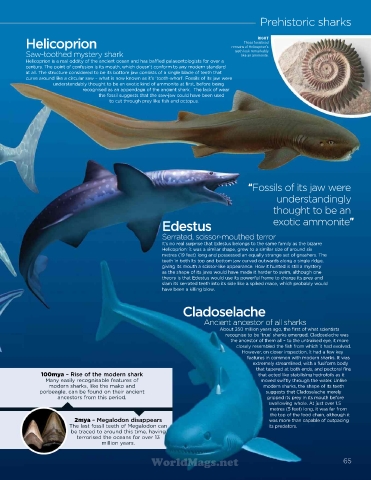
          Helicoprion                                                             remains of Helicoprion’s
                                                                                       These fossilised
                                                                                    teeth look remarkably
          Saw-toothed mystery shark                                                   like an ammonite.
          Helicoprion is a real oddity of the ancient ocean and has baffled palaeontologists for over a

          century. The point of confusion is its mouth, which doesn’t conform to any modern standard
          at all. The structure considered to be its bottom jaw consists of a single blade of teeth that
          curve around like a circular saw – what is now known as it’s ‘tooth-whorl’. Fossils of its jaw were

                    understandably thought to be an exotic kind of ammonite at first, before being
                              recognised as an appendage of the ancient shark.  The lack of wear
                                    the fossil suggests that the saw-jaw could have been used
                                       to cut through prey like fish and octopus.


                                                                                        “Fossils of its jaw were

                                                                                                  understandingly
                                                                                                 thought to be an

                                                          Edestus                                exotic ammonite”

                                                          Serrated, scissor-mouthed terror
                                                          It’s no real surprise that Edestus belongs to the same family as the bizarre
                                                          Helicoprion: it was a similar shape, grew to a similar size of around six
                                                          metres (19 feet) long and possessed an equally strange set of gnashers. The
                                                          teeth in both its top and bottom jaw curved outwards along a single ridge,
                                                          giving its mouth a scissor-like appearance. How it hunted is still a mystery
                                                          as the shape of its jaws would have made it harder to swim, although one
                                                          theory is that Edestus would use its powerful frame to charge its prey and
                                                          slam its serrated teeth into its side like a spiked mace, which probably would
                                                          have been a killing blow.


                                                                 Cladoselache

                                                                         Ancient ancestor of all sharks
                                                                              About 350 million years ago, the first of what scientists

                                                                                recognise to be ‘true’ sharks emerged. Cladoselache was
                                                                                  the ancestor of them all – to the untrained eye, it more
                                                                                    closely resembled the fish from which it had evolved.

                                                                                      However, on closer inspection, it had a few key
                                                                                        features in common with modern sharks. It was
                                                                                          extremely streamlined, with a fusiform body
                                                                                           that tapered at both ends, and pectoral fi ns
               100mya ~ Rise of the modern shark                                            that acted like stabilising hydrofoils as it
                 Many easily recognisable features of                                        moved swiftly through the water. Unlike
                  modern sharks, like the mako and                                            modern sharks, the shape of its teeth
               porbeagle, can be found on their ancient                                       suggests that Cladoselache merely
                     ancestors from this period.                                               gripped its prey in its mouth before
                                                                                               swallowing whole. At just over 1.5
                                                                                                metres (5 feet) long, it was far from
                                                                                                the top of the food chain, although it
                           2mya ~ Megalodon disappears                                          was more than capable of outpacing
                         The last fossil teeth of Megalodon can                                its predators.
                          be traced to around this time, having
                            terrorised the oceans for over 13
                                     million years.

                                                                                                                          65
                                                      WorldMags.net
                                                      WorldMags.net

