


Page 74 - World of Animals - Book of Sharks & Ocean Predators
P. 74
Sharks & Ocean Predators
                               WorldMags.net

         Amazingly, each pod of killer whales                     possible to tell which ecotype they belong   More than
        has its own dialect – a series of distinct   KILLER WHALE  to. There are actually three forms of killer
        call patterns – which gives the group its   Orcinus orca  whales: resident (the most recognised),   one orca
                                            Class Mammalia
        own unique identity. As soon as a baby                    transient and offshore. Not only do they   Take a closer look at the
        killer whale (called a calf) is welcomed into             each sound different, but they also look   different populations of killer

        the world, the family will use these calls                and act in a variety of ways. They don’t   whale in the world
        more frequently than ever. This is so that                associate with one another and one day we
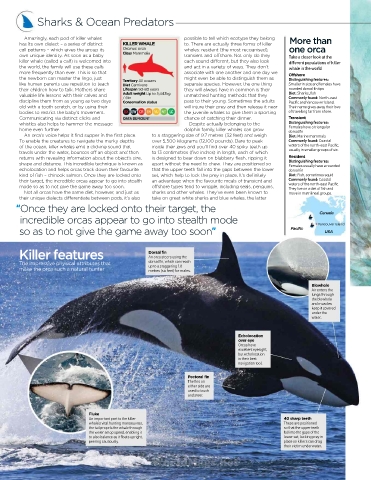
                                                                                                      Offshore
        the newborn can master the lingo, just                    might even be able to distinguish them as   Distinguishing features:
                                            Territory All oceans
        like human parents use repetition to teach   Diet Carnivore  separate species. However, the one thing   Smaller in size and females have

        their children how to talk. Mothers share   Lifespan 50-80 years  they will always have in common is their   rounded dorsal fin tips

                                            Adult weight Up to 5,443kg                                Diet: Sharks, fish
        valuable life lessons with their calves and               unmatched hunting methods that they
                                            / 6tn                                                     Commonly found: North-east
        discipline them from as young as two days   Conservation status  pass to their young. Sometimes the adults   Pacific and Vancouv er Island.

        old with a tooth scratch, or by using their               will injure their prey and then release it near   Their name gives away their love
        bodies to restrict the baby’s movement.                   the juvenile whales to give them a sporting   of travelling far from shore.
        Communicating via distinct clicks and   DATA DEFICIENT    chance of catching their dinner.    Transient
        whistles also helps to hammer the message                  Despite actually belonging to the   Distinguishing features:
                                                                                                      Females have a triangular
        home even further.                                        dolphin family, killer whales can grow

                                                                                                      dorsal fin
         An orca’s voice helps it find supper in the fi rst place.   to a staggering size of 9.7 metres (32 feet) and weigh   Diet: Marine mammals

        To enable the creatures to navigate the murky depths   over 5,500 kilograms (12,100 pounds). Dare to peek   Commonly found: Coastal


        of the ocean, killer whales emit a clicking sound that   inside their jaws and you’ll find over 40 spiky teeth up   waters of the north-east Pacific,
                                                                                                      usually in smaller groups of six.
        travels under the water, bounces off an object and then   to 13 centimetres (five inches) in length, each of which

        returns with revealing information about the object’s size,   is designed to bear down on blubbery flesh, ripping it   Resident

                                                                                                      Distinguishing features:
        shape and distance. This incredible technique is known as   apart without the need to chew. They are positioned so
                                                                                                      Females usually have a rounded
        echolocation and helps orcas track down their favourite   that the upper teeth fall into the gaps between the lower   dorsal fin

        kind of fish – chinook salmon. Once they are locked onto   set, which help to lock the prey in place. It’s defi nitely   Diet: Fish, sometimes squid

        their target, the incredible orcas appear to go into stealth   an advantage when the favourite meals of transient and   Commonly found: Coastal
                                                                                                      waters of the north-east Pacific.

        mode so as to not give the game away too soon.   offshore types tend to wriggle, including seals, penguins,

                                                                                                      They live on a diet of fish and
         Not all orcas have the same diet, however, and just as   sharks and other whales. They’ve even been known to   move in matrilineal groups.
        their unique dialects differentiate between pods, it’s also   take on great white sharks and blue whales, the latter
       “Once they are locked onto their target, the
                                                                                                                 Canada
        incredible orcas appear to go into stealth mode
                                                                                                                 Vancouver Island
        so as to not give the game away too soon”                                                      Pacifi c     USA
        Killer features                              Dorsal fi n
                                                     An orca steers using the

        The impressive physical attributes that      dorsal fin, which can reach
                                                     up to a staggering 1.8
        make the orca such a natural hunter          metres (six feet) for males.
                                                                                                               Blowhole
                                                                                                               Air enters the
                                                                                                               lungs through
                                                                                                               the blowhole
                                                                                                               and muscles
                                                                                                               keep it covered
                                                                                                               under the
                                                                                                               water.
                                                                                     Echolocation
                                                                                     over eye
                                                                                     Orcas have
                                                                                     excellent eyesight,
                                                                                     but echolocation
                                                                                     is their best
                                                                                     navigation tool.
                                                                   Pectoral fi n

                                                                   The fins on
                                                                   either side are
                                                                   used to touch
                                                                   and steer.
                                Fluke
                                An important part to the killer                                      40 sharp teeth
                                whale’s vital hunting manoeuvres,                                    These are positioned
                                the tail propels the whale through                                   so that the upper teeth
                                the water at top speed, enabling it                                  fall into the gaps of the
                                to also balance as it floats upright,                                 lower set, locking prey in

                                peering cautiously.                                                  place so killers can drag
                                                                                                     their victim underwater.
        74
                                                      WorldMags.net
                                                      WorldMags.net

