


Page 75 - World of Animals - Book of Sharks & Ocean Predators
P. 75
Killer whales
                               WorldMags.net
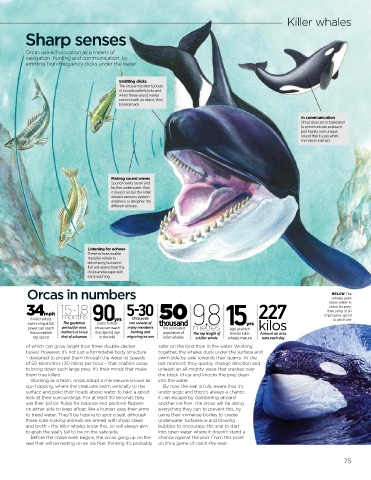
          Sharp senses


          Orcas use echolocation as a means of
          navigation, hunting and communication, by
          emitting high-frequency clicks under the water


                                           Emitting clicks
                                           The orca emits short pulses
                                           of sounds called clicks and
                                           when these sound waves
                                           connect with an object, they
                                           bounce back.

                                                                                                           In communication
                                                                                                           Orcas also use echolocation
                                                                                                           to communicate and each
                                                                                                           pod has its own unique
                                                                                                           sound that it uses when
                                                                                                           members interact.


                                        Making sound waves
                                        Sound travels faster and
                                        farther underwater than
                                        it does in air, but the killer
                                        whale’s sensory system
                                        enables it to decipher the
                                        diff erent echoes.


                                Listening for echoes
                                These echoes enable
                                the killer whale to
                                detect prey, but some
                                fish are able to hear the

                                clicks and escape with
                                early warning.

           Orcas in numbers                                                                                           BELOW The
                                                                                                                      whales peek
                                                                                                                     above water to
                                                -
                      15-18                  530         thousand9.8                                                then jump at an
                                                                                                                     check for prey,
          34 mph                 90yrs         Orca pods  50                                227                    impressive speed
            A killer whale   months                                                                                   to catch one
                                                                                  Age at which  kilos
           swimming at full   The gestation   Some female   can consist of     15yrs
           power can reach   period for orca   orcas can reach   many members   The estimated  metres
            this incredible   mothers is twice   this ripe old age   hunting and   population of   The top length of   female killer   Amount an orca
             top speed  that of a human  in the wild  migrating as one  killer whales  a killer whale  whales mature  eats each day
          of which can grow larger than three double-decker   safer on the land than in the water. Working
          buses! However, it’s not just a formidable body structure   together, the whales duck under the surface and
          – designed to propel them through the water at speeds   swim side by side towards their quarry. At the
          of 50 kilometres (30 miles) per hour – that enables orcas   last moment, they quickly change direction and
          to bring down such large prey. It’s their minds that make   unleash an all-mighty wave that crashes over
          them true killers.                             the block of ice and knocks the prey clean
            Working as a team, orcas adopt a manoeuvre known as   into the water.
          spy-hopping, where the creatures swim vertically to the   By now the seal is fully aware that it’s
          surface and poke their heads above water to take a good   under siege and there’s always a chance
          look at their surroundings. For at least 30 seconds they   it can escape by clambering aboard


          use their tail (or fluke) for balance and pectoral fl ippers   another ice floe. The orcas will be doing

          on either side to keep afloat, like a human uses their arms   everything they can to prevent this, by
          to tread water. They’ll be hoping to spot a seal, although   using their immense bodies to create
          these cute-looking animals are armed with sharp claws   underwater turbulence and blowing
          and teeth – the killer whales know this, so will always aim   bubbles to encourage the seal to dart
          to grab the seal’s tail to be on the safe side.  into open water where it doesn’t stand a
            Before the chase even begins, the orcas gang up on the   chance against the pod. From this point

          seal that will be resting on an ice floe, thinking it’s probably   on it’s a game of catch-the-seal-
                                                                                                                          75
                                                      WorldMags.net
                                                      WorldMags.net

