


Page 81 - World of Animals - Book of Sharks & Ocean Predators
P. 81
Killer whales
                               WorldMags.net


             They are great team players                                                      They can hunt just
                                                                                              like bats
              Killer whales form close-knit bonds with their fellow pod                       Killer whales can detect their next meal
              members, which on average tends to number around
                                                                                              in murky water or even at night by
              40 individuals. They do everything together, spending                           making clicking sounds and listening
              their time travelling in search of food, playing, hunting                       for the resulting echoes. Studies have
              and resting. They have developed some ingenious
              collaborative tactics for capturing prey, including taking                      shown they can even pinpoint specifi c
                                                                                              prey using this technique. They use this
              turns to chase down a victim until it’s exhausted and
              creating waves to knock stranded animals off ice fl oes.                         same echolocation ability to navigate.
                                                                                              Unlike bats, orcas also have acute
                                                                                              vision, so they can use both senses
                                                                                              individually or together, depending on
                                                                                              the environmental conditions.
                                                                                              Every pod has its
                                                                                              own dialect
                                                                                              Very social creatures, killer whales use a
                                                                                              complex series of whistles, pulsed calls
                                                                                              and clicks to communicate with one
                                                                                              another. There are similarities in signals
                                                                                              across all groups, but nevertheless,
                                                                                              scientists have detected distinct
                                                                                              variations, not just between regions but
                                                                                              even from pod to pod.
            They listen through                                                               Killer whales will
            their jaws                                                                        sometimes eat sharks
            Although the orca’s physical ears are two                                         Sharks usually sit quite comfortably
            small holes located just below the eyes,                                          at the top of the food chain, but even
            several parts of the head contribute to                                           they need to take care if killer whales
            its hearing. It targets clicks in a beam                                          are around. In 2014, marine biologists
            from the bump on its head called the                                              captured a video of an orca pod
            melon, then perceives the majority of the                                         harrying a tiger shark until it fl ipped
            returning echoes via its fat-fi lled lower                                         over. There have even been sightings of
            jawbone, through which the vibrations                                             orcas taking on great whites!
            pass to the inner ears.
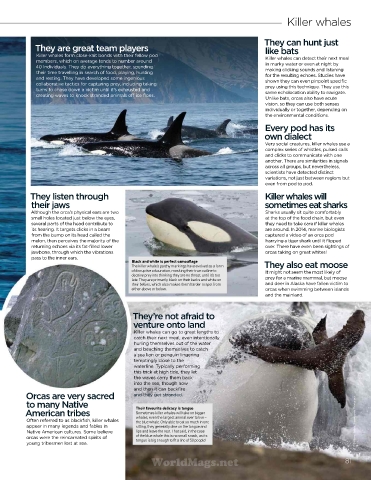
                                               Black and white is perfect camoufl age
                                               The killer whale’s patchy markings have evolved as a form   They also eat moose
                                               of disruptive colouration, masking their true outline to   It might not seem the most likely of
                                               deceive prey into thinking they are no threat, until it’s too
                                               late. They are primarily black on their backs and white on   prey for a marine mammal, but moose
                                               their bellies, which also makes them harder to spot from   and deer in Alaska have fallen victim to
                                               either above or below.                         orcas when swimming between islands
                                                                                              and the mainland.


                                                They’re not afraid to
                                                venture onto land
                                                Killer whales can go to great lengths to
                                                catch their next meal, even intentionally
                                                hurling themselves out of the water
                                                and beaching themselves to catch
                                                a sea lion or penguin lingering
                                                temptingly close to the
                                                waterline. Typically performing
                                                this trick at high tide, they let
                                                the waves carry them back
                                                into the sea, though now
                                                and then it can backfi re
          Orcas are very sacred                 and they get stranded.
          to many Native                         Their favourite delicacy is tongue
          American tribes                        Sometimes killer whales will take on bigger
                                                 whales, even the largest animal ever to live –

          Often referred to as blackfish, killer whales   the blue whale. Only able to eat so much in one                      © Alamy; Ardea; Dreamstime; Thinkstock
          appear in many legends and fables in   sitting, they generally dine on the tongue and
          Native American cultures. Some believe   lips and leave the rest. That said, in the case
                                                 of the blue whale this is no small snack, as its
          orcas were the reincarnated spirits of
                                                 tongue is big enough to fit a line of 50 people!

          young tribesmen lost at sea.
                                                                                                                          81
                                                      WorldMags.net
                                                      WorldMags.net

