


Page 176 - (DK) Home Doctor: Providing practical advice on home treatments
P. 176
174 FIRST AID

         Swallowed poisons


              If a poisonous substance is swallowed it can harm the mouth and
                                                                            WARNING
              digestive tract; it may also get into the bloodstream and cause
              further damage. Household products such as bleach, dishwasher  Call the Poison Control Center
                                                                     800-222-1222 (US) 800-268-9017 (Can)
              detergent, and paint stripper contain strong chemicals that are
                                                                     A person who has swallowed a poison
              poisonous, and many medicines are harmful if taken in excessive
                                                                     needs emergency medical attention.
              doses. Some plants and fungi are poisonous if eaten. The effects
              of poisoning vary, but there may be vomiting, a burning sensation
              or pain in the esophagus or abdomen, and loss of consciousness.


                                         PRACTICAL TECHNIQUE

              Dealing with swallowed poisons
              The most important step is to arrange medical help. Try to
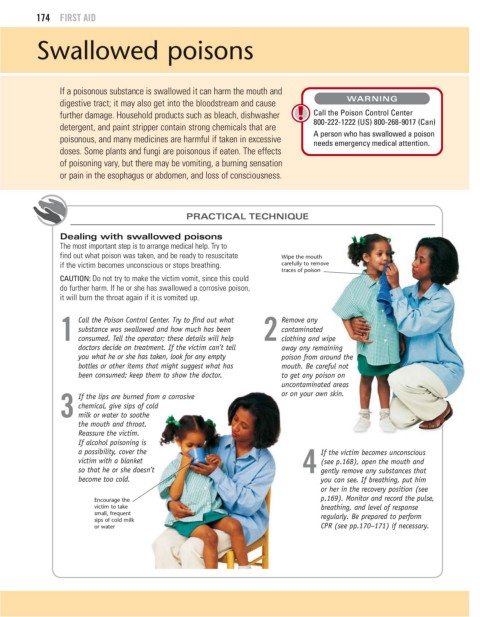
              find out what poison was taken, and be ready to resuscitate  Wipe the mouth
              if the victim becomes unconscious or stops breathing.   carefully to remove
                                                              traces of poison
              CAUTION: Do not try to make the victim vomit, since this could
              do further harm. If he or she has swallowed a corrosive poison,
              it will burn the throat again if it is vomited up.

                  Call the Poison Control Center. Try to find out what  Remove any
                  substance was swallowed and how much has been  contaminated
              1 consumed. Tell the operator; these details will help 2 clothing and wipe
                  doctors decide on treatment. If the victim can’t tell  away any remaining
                  you what he or she has taken, look for any empty  poison from around the
                  bottles or other items that might suggest what has  mouth. Be careful not
                  been consumed; keep them to show the doctor.  to get any poison on
                                                              uncontaminated areas
                  If the lips are burned from a corrosive     or on your own skin.
                  chemical, give sips of cold
              3 milk or water to soothe
                  the mouth and throat.
                  Reassure the victim.
                  If alcohol poisoning is
                  a possibility, cover the                            If the victim becomes unconscious
                  victim with a blanket                               (see p.168), open the mouth and
                  so that he or she doesn’t                       4 gently remove any substances that
                  become too cold.                                    you can see. If breathing, put him
                                                                      or her in the recovery position (see
                     Encourage the                                    p.169). Monitor and record the pulse,
                     victim to take                                   breathing, and level of response
                     small, frequent
                     sips of cold milk                                regularly. Be prepared to perform
                     or water                                         CPR (see pp.170–171) if necessary.

