


Page 172 - (DK) Home Doctor: Providing practical advice on home treatments
P. 172
170 FIRST AID

         CPR – Rescue breathing


              If a victim is unconscious and has stopped breathing, you
                                                                            WARNING
              can supply oxygen to keep him or her alive by blowing your own
              exhaled air into his or her lungs. This technique, called rescue  Call 911.
              breathing, is the first stage of cardiopulmonary resuscitation  Send a helper to call 911 if a victim
                                                                     is not breathing.
              (CPR). Rescue breathing is also used with chest compressions
              (see opposite page) in the second stage of CPR.


                                         PRACTICAL TECHNIQUE
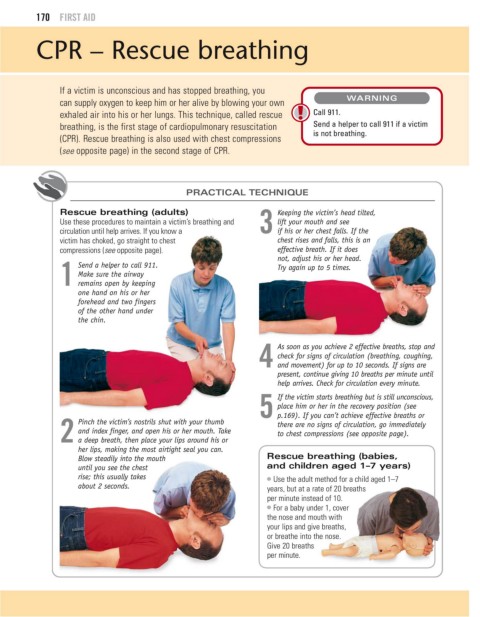
              Rescue breathing (adults)                      Keeping the victim’s head tilted,
              Use these procedures to maintain a victim’s breathing and  lift your mouth and see
              circulation until help arrives. If you know a  3 if his or her chest falls. If the
              victim has choked, go straight to chest        chest rises and falls, this is an
              compressions (see opposite page).              effective breath. If it does
                                                             not, adjust his or her head.
                  Send a helper to call 911.                 Try again up to 5 times.
                  Make sure the airway
              1 remains open by keeping
                  one hand on his or her
                  forehead and two fingers
                  of the other hand under
                  the chin.

                                                             As soon as you achieve 2 effective breaths, stop and
                                                             check for signs of circulation (breathing, coughing,
                                                         4 and movement) for up to 10 seconds. If signs are
                                                             present, continue giving 10 breaths per minute until
                                                             help arrives. Check for circulation every minute.
                                                             If the victim starts breathing but is still unconscious,
                                                             place him or her in the recovery position (see
                                                         5 p.169). If you can’t achieve effective breaths or
                  Pinch the victim’s nostrils shut with your thumb  there are no signs of circulation, go immediately
                  and index finger, and open his or her mouth. Take  to chest compressions (see opposite page).
              2 a deep breath, then place your lips around his or
                  her lips, making the most airtight seal you can.
                  Blow steadily into the mouth             Rescue breathing (babies,
                  until you see the chest                  and children aged 1–7 years)
                  rise; this usually takes                 ● Use the adult method for a child aged 1–7
                  about 2 seconds.
                                                           years, but at a rate of 20 breaths
                                                           per minute instead of 10.
                                                           ● For a baby under 1, cover
                                                           the nose and mouth with
                                                           your lips and give breaths,
                                                           or breathe into the nose.
                                                           Give 20 breaths
                                                           per minute.

