


Page 68 - (DK) Home Doctor: Providing practical advice on home treatments
P. 68
66   COMMON CONDITIONS: EYE AND EAR PROBLEMS

         Popping ears


              The feeling of “popping ears” is common during air travel, scuba diving, or even when you travel up or down
              steep hills in a car. It is due to a difference in pressure between the outside environment and your middle
              ear, which makes your eardrum bulge and may cause pain, a muffled feeling, ringing in your ears, and
              temporary hearing loss. Normally, pressures are kept equal by air flowing in and out of the middle ear via the
              eustachian tubes, which link the middle ear to the nose and throat, but during rapid ascent or descent the
              tubes are too narrow to manage. Babies and young children have short, narrow tubes and are particularly
              prone to popping ears. Your ears are also more likely to pop if you have a blocked nose.


         What you can do yourself
                                                                PRACTICAL TECHNIQUE
              There are several steps that you can take to help
              equalize the pressure in your ears. The discomfort  Unblocking your ears Try the following
              of popping ears usually disappears 3–5 hours after  action to relieve discomfort and unblock your ears.
              air pressure has stabilized.                  You may need to do this several times during ascent
                                                            or descent.
              ● On a plane, chew gum or suck on a hard candy
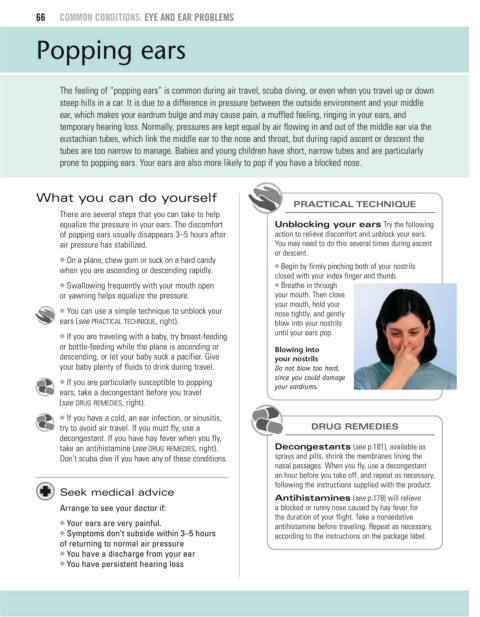
                                                            ● Begin by firmly pinching both of your nostrils
              when you are ascending or descending rapidly.
                                                            closed with your index finger and thumb.
              ● Swallowing frequently with your mouth open   ● Breathe in through
              or yawning helps equalize the pressure.       your mouth. Then close
                                                            your mouth, hold your
              ● You can use a simple technique to unblock your  nose tightly, and gently
              ears (see PRACTICAL TECHNIQUE, right).        blow into your nostrils
                                                            until your ears pop.
              ● If you are traveling with a baby, try breast-feeding
              or bottle-feeding while the plane is ascending or  Blowing into
              descending, or let your baby suck a pacifier. Give  your nostrils
              your baby plenty of fluids to drink during travel.   Do not blow too hard,
                                                            since you could damage
              ● If you are particularly susceptible to popping
                                                            your eardrums.
              ears, take a decongestant before you travel
              (see DRUG REMEDIES, right).
              ● If you have a cold, an ear infection, or sinusitis,
              try to avoid air travel. If you must fly, use a       DRUG REMEDIES
              decongestant. If you have hay fever when you fly,
              take an antihistamine (see DRUG REMEDIES, right).  Decongestants (see p.181), available as
              Don’t scuba dive if you have any of these conditions.  sprays and pills, shrink the membranes lining the
                                                            nasal passages. When you fly, use a decongestant
                                                            an hour before you take off, and repeat as necessary,
                                                            following the instructions supplied with the product.
              Seek medical advice
                                                            Antihistamines (see p.178) will relieve
              Arrange to see your doctor if:                a blocked or runny nose caused by hay fever for
                                                            the duration of your flight. Take a nonsedative
              ● Your ears are very painful.
                                                            antihistamine before traveling. Repeat as necessary,
              ● Symptoms don’t subside within 3–5 hours
                                                            according to the instructions on the package label.
              of returning to normal air pressure
              ● You have a discharge from your ear
              ● You have persistent hearing loss

